Humans
 PUBLISHED


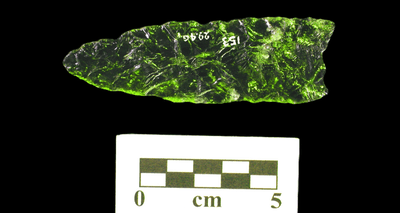


The earliest hunter-gatherers in the Americas were expert stone knappers, and fashioned a variety of tools and weapons out of high-quality chert. Known as the Clovis people, this prehistoric culture also produced a small number of artifacts out of quartz crystal, indicating that they may have attributed certain spiritual qualities to this material.
Due to its hardness and macro-crystalline structure, quartz crystal is considered inferior to chert as a raw material for tool production. It’s also much more difficult to flake into functional items with sharp cutting edges.
Despite this, researchers have discovered 58 quartz crystal projectile points at Clovis sites across North America. Analyzing the morphology of these weapons, the authors of a recent study found that they are virtually indistinguishable from chert points found at the same sites, despite being slightly smaller on average.
Most cultures consider crystals to have some sort of power.
Briggs Buchanan
Though harder than obsidian, quartz crystal is roughly equal to chert in terms of robustness, with both materials scoring seven on the Mohs hardness scale. For this reason, it seems unlikely that the crystals were selected for their solidity, given the abundance of higher quality and more amenable toolstones available to Clovis hunter-gatherers.
However, because quartz crystal is somewhat rare, the study authors speculate that it may have held some sort of “ritual, ceremonial, or supernatural importance” to the Clovis, and that tools made of this material might have been imbued with special powers.
“We think a reasonable explanation for why Clovis people went to the trouble of finding and making points out of quartz crystal is that quartz crystal possesses properties – translucency, triboluminescence [sparking when struck], crystalline shape, rarity – that other knappable raw materials do not and these were attractive to Clovis peoples,” said study author Briggs Buchanan from the University of Tulsa in an email to IFLScience.
“What we can do is look at the ethnographic record at traditional cultures across the world and how they view similar crystal objects. When we do this, we see that most cultures consider crystals to have some sort of power,” adds Buchanan. “Based on common descent we speculate that the earliest widespread hunter-gatherer cultures in North America may have held similar beliefs, but we cannot know for sure.”
To gain a clearer idea of how quartz crystals were perceived and used by the Clovis, the study authors scoured the archaeological record for other types of tool made out of this material. They found examples of bifaces, scrapers, wedges, spokeshaves and flakes – all made of quartz crystal – at Clovis sites in different areas of North America.
Puzzlingly, however, these crystal tools were found jumbled up with utensils made from other toolstones at Clovis campsites, kill sites, and lithic caches. This suggests that quartz crystal tools were used in the same way as chert tools, and weren’t reserved for ceremonial or symbolic tasks.
The study authors therefore suggest that these unusual items may have been considered both functional and non-functional at the same time, meaning they might have been used by the Clovis in the same way as other tools while still being considered special in some way.
“Unfortunately, we do not know how Clovis people would have viewed quartz crystal points and whether they considered them to hold supernatural qualities or simply used them as functional tools,” concludes Buchanan.
The study is published in the journal Lithic Technology.


 7
7