Humans
 PUBLISHED



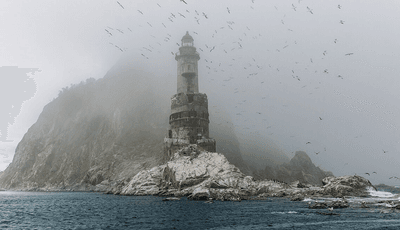


No one wants to be a lighthouse keeper on the Arctic coast of the Far North, not even the hardiest of Russian hardmen. To manage this personnel problem, the USSR came up with a bold plan: to line its icy shores with nuclear-powered lighthouses. It was a good idea, until it wasn’t.
The northern edge of Russia’s vast land expanse stretches along the Arctic Ocean for 24,140 kilometers (15,000 miles) of coastline. It watches over the Northern Sea Route, an important artery of international shipping connecting Asia and Europe, at least during the summer months when it isn't choked with ice.
As industrialization ramped up in the 20th century, shipping boomed along this treacherous route, and it became apparent that lighthouses would be needed to guide the way.
With an incredibly cold and harsh climate, Russia’s Extreme North is sparsely populated. Its wealth of mineral and natural resources means that some people do live and work here, but the idea of manning a lighthouse in these conditions seemed impractical and cruel, even by Stalinist standards.
There Is a Light That Never Goes Out (at least for a few years)
To solve this, the Soviets built hundreds of automated lighthouses along its northern coastline powered by Radiological Thermoelectric Generators (RTGs). These gadgets are not nuclear power plants, nor even nuclear batteries, but relatively simple devices that convert the heat from radioactive decay into electricity.
It's the same technology that has been powering the Voyager spacecraft since the 1970s as it continues to blast into outer space, as well as other space exploration missions like Cassini and New Horizons.
However, unlike the American models, which used pricey plutonium-238, the Soviets went for the cheaper option of using strontium-90, caesium-137, or cerium-144. These are all the waste products of spent nuclear fuel.
Each RTG unit could put out a steady 7 to 30 volts and up to 80 watts of power, with a working life of 10 to 20 years. They did the job, but the Russians would later pay the price for skimping on the crude designs.
When RTGs go bad
When the Soviet Union collapsed in 1991, there were almost 200 RTG-powered lighthouses in the Murmansk and Arkhangelsk regions of northwest Russia, not to mention the unknown number of others dotted along the Far North’s coast to the east.
However, as the Russian economy collapsed and the old Soviet engineering systems faded away, these lighthouses were left to fall into ruins.
Over the following decades, the International Atomic Energy Agency documented several instances in which these decaying RTG systems became a real radiological nuisance.
In 1999, for instance, an RTG device was found emitting radioactivity at a bus stop in the town of Kingisepp, close to the border with Estonia. It turned out to have been stolen from a lighthouse by looters looking for metals to scavenge.
In 2001, another incident saw three woodsmen stumble across some heat-emanating ceramic objects near their campsite in the remote Inguri River valley of Georgia. Unbeknownst to them at the time, they were two more RTGs from the Soviet era. Two of the men had to be treated for radiation sickness and severe radiation burns.
Realizing this as a problem, neighboring Norway stepped up in 1997 and led a charge to clear up these rogue RTGs in northwest Russia.
Within a decade, they safely removed around 60 RTGs from lighthouses on the Kola Peninsula, replacing them with solar panels and nickel-cadmium battery packs. However, the situation further to the east is still a bit of a mystery.
Aniva Lighthouse
The legacy of Russia’s nuclear-powered lighthouses flickered into the 21st century, though.
One of the most famous (and certainly the most picturesque) is known as the Aniva Lighthouse. It was built by the Japanese near Sakhalin Island in the 1930s when they controlled the region. After World War II, the USSR claimed the territory.
The lighthouse was initially managed by a crew but, oddly enough, it was fitted with an RTG in the ‘90s, after the Soviet system collapsed.
The light kept shining until 2006, when the radioactive core was finally removed and the lighthouse was abandoned for good. It now lies in ruins as a quiet but beautiful reminder of this very strange chapter of Cold War engineering.