Humans
 PUBLISHED
 5
5


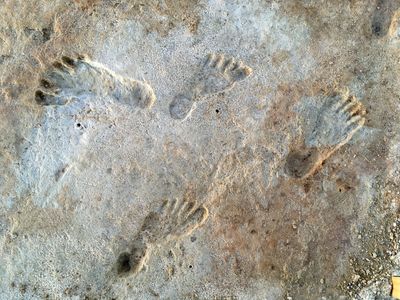


We still don’t know exactly when humans first reached the Americas, although we do know that people were present in New Mexico by around 23,000 years ago. All that remains of these mysterious ancient wanderers are a few footprints, and while some researchers have questioned the age of these tracks, new research confirms that they were made 10 millennia before the emergence of the first major culture in North America.
Found in a layer of sediment that was once the bed of an ancient stream at a site called White Sands, the prints are the oldest in the continent by some distance. Back in 2021, researchers dated seeds and pollen from the same sediment layer, providing an age of 23,000 to 21,000 years, although this finding has not gone unchallenged.
“The criticism, in part, was that these plants were taking in old water,” explained Professor Vance Holliday from the University of Arizona. By arguing that the water inside the plants predated the sediment layer, scholars were able to cling to the notion that humans didn’t spread across North America until around 14,000 years ago, when traces of the Clovis culture begin to appear in the archaeological record.
However, returning to White Sands in 2022 to study a separate site at a dried-up lakebed a few kilometers from the ancient tracks, Holliday made a surprising discovery. “Some of the beds with the human tracks, they're red [sediment], and you could literally trace them from where the human tracks are, right into where we were working in these lake beds,” he told IFLScience.
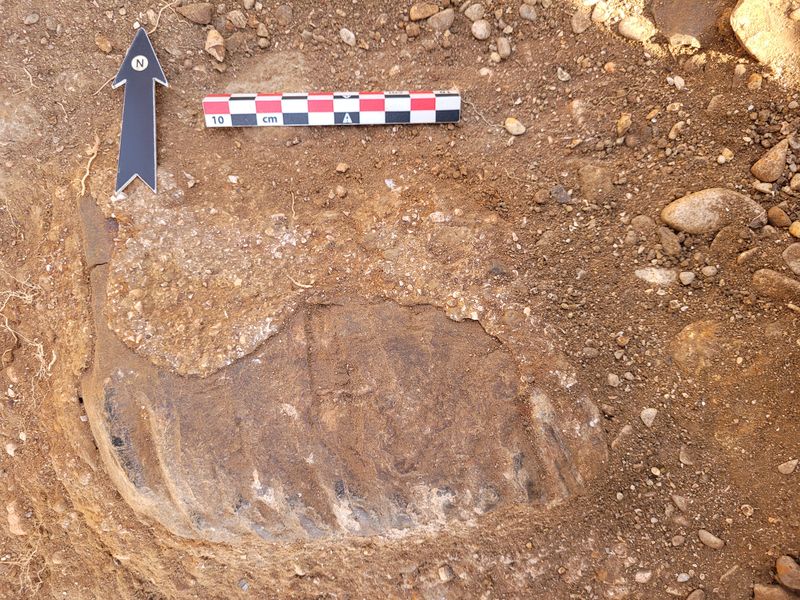
Sandwiched between white, green, and black sediment layers – representing gypsum, lake clays, and mud – the red strata were made of material that had blown in from nearby mountains, and offered Holliday an opportunity to directly date the very layer that contained the tracks. When the results came back, the red sediment clocked in at between 22,400 and 20,700 years old, which fits in nicely with the previous estimates.
Between two separate research groups and three different labs, a total of 55 samples have now been radiocarbon dated, and all appear in agreement with each other regarding the age of the footprints. “It’s a remarkably consistent record,” said Holliday in a statement.
But with the age of the tracks now confirmed, researchers are hard-pressed to explain the existence of these hunter-gatherers during a time period that lacks any cultural artifacts. “This is 10,000 years older than Clovis, and there's no good record for people in the Americas at that age,” Holliday told IFLScience.
“There's just no tradition of any kind. There's no biological tradition, no artifact tradition, and of course, if you did have a continuous occupation, you would expect to see more people through time, and you just don't.”
Like a kind of Paleo-Cinderella story, researchers know literally nothing about these enigmatic characters apart from their shoe size. “All we know from the tracks is that they're going from A to B, but we don't know where A was or where B was,” says Holliday.
Speculating on why we have no record of this pre-Clovis culture, he goes on to say that the simplest explanation is there simply wasn’t one. “To me, it just looks like little dribblets of human populations get over [to North America] and then become extinct. It wasn't until Clovis, where you really have a solid, continent wide adaptation, that people finally get a good hold and thrive.”
The study has been published in the journal Science Advances.