Nature
 PUBLISHED


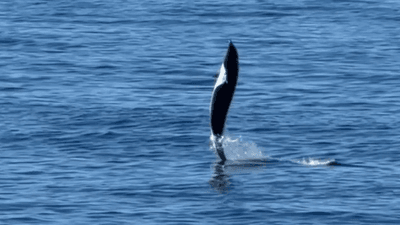


It’s not uncommon to see a dolphin with the zoomies – they’re some of the most playful ocean creatures that we know of – but “walking” on their tails at the same time? Now that’s a rare sight for dolphins in the wild – and it’s one that some lucky whale watchers were recently treated to on a trip off the California coast.
Known as “tail walking”, this unusual behavior involves dolphins launching themselves out of the water with their bodies upright, then holding this position by rapidly moving their tails, allowing them to briefly skip or “walk” over the water’s surface.
In this case, the individual that clearly felt like being horizontal wasn’t the vibe that day was a northern right whale dolphin (Lissodelphis borealis), a relatively common species in the North Pacific Ocean that is distinguished by its lack of a dorsal fin, and its mostly black body with a white patch underneath.
Despite the name, we can confirm that this is in fact a dolphin, not a whale. According to Whale and Dolphin Conservation, the reason why it shares a name with the Northern (better known as North Atlantic) right whale is because neither has a dorsal fin. You can thank whoever’s in charge of giving cetaceans their common names for the confusion.
While they’re well-known for their acrobatic antics – they can leap over 6 meters (20 feet) over the water – it’s not often that you’ll see one tail walking.
In footage of the dolphin captured by Evan Brodsky on January 18, the trip’s guide can be heard saying, “I can’t express to you how uncommonly rare this behavior is.” And they’re not wrong – in an Instagram post, Monterey Bay Whale Watch (the organization behind the trip) said it had only documented tail walking “a handful of times”, and these are people who see dolphins leaping about all the time.
One of the most notable occurrences of tail walking outside of captivity that we know of was observed in a population of wild Indo-Pacific bottlenose dolphins (Tursiops aduncus) living in Australia’s Port River estuary, and thanks to a study covering 30 years' worth of data, we know where it came from too.
It turns out that the wild dolphins in question likely picked the behavior up from a female dolphin called Billie. Born in the wild in 1987, she ended up stuck in a harbor in December of the same year, and was rehabilitated at a nearby dolphinarium alongside five individuals that had been trained to tail walk as part of public dolphin shows.
Seven years after her release back into the wild, Billie was spotted tail walking – and the behavior ended up spreading to several other dolphins in the estuary’s population, eventually winding down a few years after Billie’s death in 2009. While she didn’t get any training at the dolphinarium, it’s thought that she was imitating what she had seen the trained dolphins doing, and the wild dolphins imitated her in turn.
How exactly the sprightly northern right whale dolphin seen more recently came to adopt the tail walking behavior is unclear, but it’s certainly amazing to see – as are dolphins wearing sea sponge “wigs”.