


 Nature
 PUBLISHED



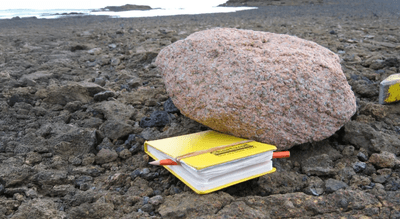


On top of the Hudson Mountains in West Antarctica, strange pink boulders stand starkly against a backdrop of ice, snow, and dark volcanic rock. Perched in the mountain peaks, their presence seems unexpected at first glance, as if they were placed by a giant or plonked there from another world. However, recent research has revealed a far more grounded explanation that lurks beneath the ice-capped region.
In a project last year, scientists led by the British Antarctic Survey (BAS) were able to trace the origins of the pink granite in the Hudson Mountains and uncover how it arrived in such an unlikely setting.
By analyzing the radioactive decay of elements in the rock crystals, the team determined they formed around 175 million years ago, during the Jurassic Period.
Another piece of the puzzle came from aircraft surveys of the region that detected small variations in gravitational pull around the southern Hudson Mountains. This gravity anomaly indicated that something lay deep beneath the mountain's Pine Island Glacier – it was a hidden subglacial body of granite measuring 100 kilometers (62 miles) wide and 7 kilometers (4.3 miles) thick.
After ruling out other explanations, these two lines of evidence suggest the pink rocks reached the mountaintop at a time when the glacier behaved very differently. Glaciers are constantly shifting shape, albeit very slowly, moving like a super-thick syrup over the course of centuries and millennia. Over vast periods of time, the glacier appears to have collected rocks from the now-hidden granite body and carried them uphill.
The pink granites are what’s known as “glacial erratics”; rocks transported long distances from their place of origin by the slow-moving flow of ice. It's more common for glaciers to carry geological debris down slopes under their own weight, but under certain conditions, it’s possible for them to move material uphill and across land when ice sheets change in shape, size, or direction of flow.
"It's remarkable that pink granite boulders spotted on the surface have led us to a hidden giant beneath the ice,” Dr. Tom Jordan, lead author and geophysicist at BAS, said in a statement. “By combining geological dating with gravity surveys, we've not only solved a mystery about where these rocks came from, but also uncovered new information about how the ice sheet flowed in the past and how it might change in the future.”
The vast timescales involved can make it difficult to gauge exactly how glaciers behave, but ancient rocks can act like literal milestones, recording their journeys in the past.
In the 21st century, the processes that shape glaciers have grown more complex still. Rising temperatures are driving ice loss at an unprecedented rate across the world, not least in Antarctica, making these ancient rocky records all the more valuable to scientists.
"Rocks provide an amazing record of how our planet has changed over time, especially how ice has eroded and altered the landscape of Antarctica. Boulders like these are a treasure-trove of information about what lies deep beneath the ice sheet, far out of reach,” explained Dr. Joanne Johnson, study co-author and geologist at BAS, who collected the boulders during fieldwork in the Hudson Mountains.
"By identifying their source, we have been able to piece together how they got to where they are today, giving us clues about how the West Antarctic Ice Sheet may change in future -- information that is vital for determining the impact of sea level rise on coastal populations around the world."
The study was published in Nature Communications Earth & Environment in October 2025.




 1
1