Nature
 PUBLISHED





What you’ll discover in this article…
- ZooTampa in Florida has incorporated acupuncture as a complementary therapy to traditional treatment options in veterinary care.
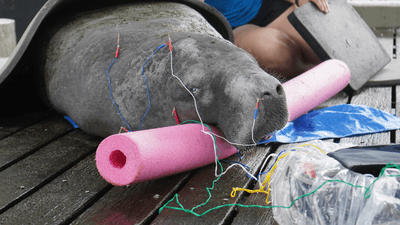
- The therapy has already been used on a duck named Earl Grey, and a manatee called Sloth.
- As Dr Alex Mason told IFLScience, “It can be useful to apply acupuncture in order to speed recoveries, enhance comfort and help to wake up nerves depending on the conditions we are treating.”
The ancient practice of acupuncture dates back around 3,000 years. You’ve probably seen it on TV or in person – how needles are applied to precise "acupoints" points across the body. What you probably haven't seen, however, is somebody doing acupuncture on a duck – never mind a manatee.
These animals are residents of ZooTampa at Lowry Park in Florida, where veterinarian Dr Alex Mason is leading a new initiative to incorporate acupuncture into veterinary care.
“Acupuncture can complement our traditional therapies by helping to enhance healing through increasing blood flow and circulating stem cells, aiding in faster healing times,” Mason told IFLScience.
“[It] can help to stimulate nerves for neuropathies and neurologic conditions and can enhance comfort and quality of life through endorphin and serotonin release that act at the same receptors as opioid pain medications do!”
Acupuncture: does it work?
An exciting prospect, and acupuncture is used fairly commonly by physiotherapists and medical professionals, but it's worth noting that it's still considered to be an alternative or complementary medicine.
What that means is its efficacy as a treatment is debated, and some studies (such as this 2016 look at back pain and this 2021 analysis of several studies on neck pain) have found specific applications to be no more beneficial than a placebo – otherwise known as a "sham" version of the treatment.
Chronic cases can be a challenge and take more sessions to show larger improvements
Alex Mason
However, in 2021 a new study in mice became the first to find a potential explanation for how certain "acupoints" – the places needles are typically inserted – might function. Researchers found they could stimulate the sciatic nerve in mice by applying an electric current through acupuncture needles (known as electroacupuncture) at the mouse equivalent of an acupoint called ST36.
This caused an increase in dopamine secretion by the adrenal gland that, theoretically, could activate signaling pathways associated with a reduction in systemic inflammation. The findings aren't necessarily relevant to every kind of acupuncture treatment because this work specifically used electrical stimulation and only looked at what happens in mice.
So, what results has ZooTampa seen from electrostimulation of its animals?
Earl Grey the duck
A black-bellied whistling duck named Earl Grey presented at ZooTampa with sudden weakness in his right leg. X-rays were taken, and the bird was given pain management, but to complement these traditional approaches, Mason also elected to try out electroacupuncture.
For Earl Grey, the combination of treatments appears to have worked.
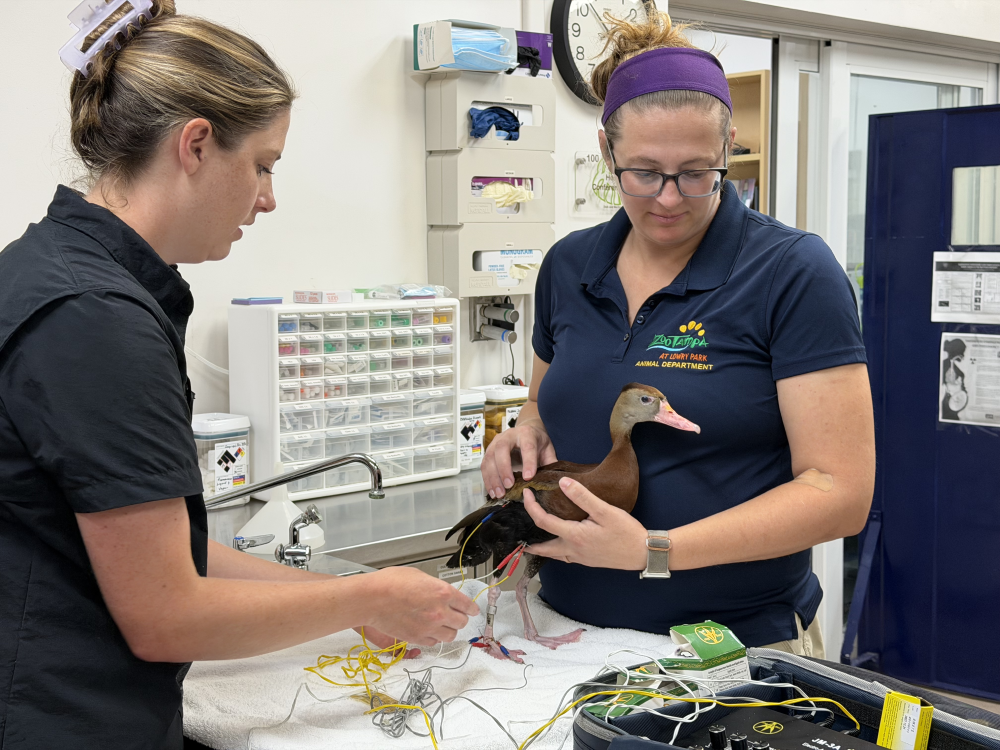
“After two acupuncture sessions in addition to fluids, vitamins, and pain medications, he is now bearing weight and using the limb very well!” said Mason. “We are continuing to monitor him and provide additional sessions as needed.”
A roseate spoonbill chick was also given the therapy for treatment of her dysfunctional leg. Through a combination of physical therapy, medical management, pain meds, and acupuncture, the limb is now functional.
And Mason’s patients extend beyond birds.
A manatee named sloth
Sloth was brought to ZooTampa for rehabilitation following an injury that’s suspected to have been caused by a boat strike. The manatee now has right-sided facial paralysis, impacting his ability to close one nostril or blink one eye.
Chronic nerve injuries are notoriously difficult to treat, which was why Mason felt the complementary therapy of acupuncture could be worth a shot.
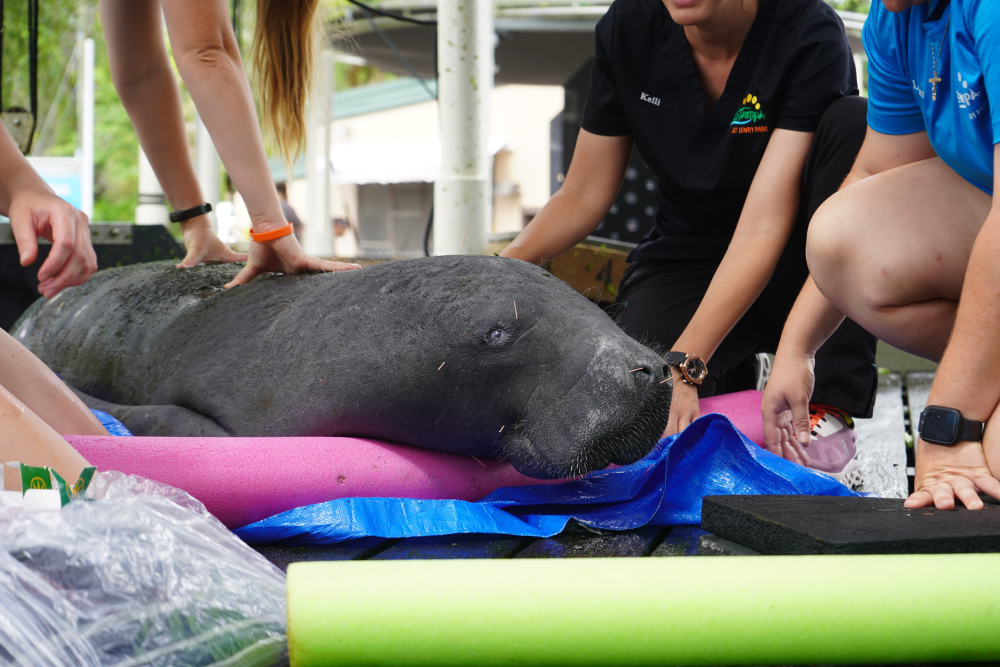
“While his treatment is still ongoing, he has made initial mild improvements and can now open the right nostril ~30% and retro pulse the eye into the socket more than he was noted to be doing before treatment (although he can still not fully blink the eye),” said Mason.
“Chronic cases can be a challenge and take more sessions to show larger improvements, and at this time his treatment continues to be ongoing.”
The zoo plans to continue incorporating acupuncture into its veterinary care when it may benefit an animal’s recovery in tandem with traditional treatment options, but not as a stand-alone therapy.
For now, that's probably a wise move, as evidence either way for animal acupuncture is a little thin on the ground. A 2024 review found there was insufficient evidence that regular acupuncture alone provided effective pain relief, at least in dogs with canine hip dysplasia.
That paper also recognized that research in the field as a whole is a bit patchy, and that – in the context of pets – it's possible some of the beneficial effects could be down to the owner’s perception rather than the procedure's efficacy for pain relief.
The situation for electroacupuncture specifically is slightly better. But still, a 2022 analysis of several studies concluded that more research, using better study design and yielding higher quality results, was needed to confirm any beneficial effects.
For that reason, it’s important to always seek a veterinary expert’s advice on how to treat our animal pals. As the research continues, we're keeping everything crossed that Sloth's winking days will soon be over.