Space and Physics
 PUBLISHED


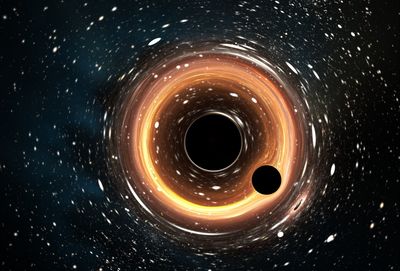


An international team of astronomers reports an incredible discovery: A massive elliptical galaxy appears to have a hollow cavity in its core, like a billion stars had been kicked out from it. The observation suggests the presence of not one but two ultramassive black holes. If confirmed, one of them might be the largest black hole known, and it would definitely be the heaviest pair ever found.
The galaxy in question is at the center of galaxy cluster A402. Central cluster galaxies tend to be elliptical and the most massive objects around. Galaxy collisions and other modes of accretion deliver mass towards this object, which eventually becomes the big boss in the neighborhood.
“At the very center of this galaxy are two distinct features: a bright pointlike source at the galaxy center, and a kiloparsec-wide dark region to the east of this source,” the authors wrote in the paper detailing the new discovery.
The pointlike source is believed to be an ultramassive black hole, with an estimated mass of 50 billion times the mass of our Sun – a single object weighing 25 times the mass of all the stars in the Large Magellanic Cloud, one of the neighboring galaxies of the Milky Way. The stellar mass of the Milky Way is between 100 and 400 billion times that of the Sun, so this one black hole might be half of our own galaxy, and it is not alone.
Using JWST and Hubble observations, followed up with the MUSE instrument on the Very Large Telescope, the team revealed the presence of a cavity about 17,600 cubic light-years in size. They estimate that about 1 billion solar masses worth of stars are missing from this are, and maybe 10 times as much when considering dark matter too.
Removing such a mass from the deep gravitational potential well of such a massive galaxy requires something formidable. The proposal, backed by the MUSE observations, is a second ultramassive black hole. Their total combined mass is 60 billion times the mass of the Sun.
The team does not believe this to be a unique system, though it is extreme. Last year, another ultramassive black hole of about 36 billion solar masses was found, for example. The central cavity might also be used to find other systems such as this in archival data from JWST and Hubble, as well as from Euclid and the upcoming Roman telescope.
These discoveries might then be used by LISA, the space-based gravitational wave observatory, which will look for the gravitational emission of these supermassive black hole pairs.
The study is published in The Astrophysical Journal Letters.