Space and Physics
 PUBLISHED





Astronomers have used the ages of stars to identify the point where the Milky Way’s disk becomes so diffuse that stars haven’t formed. Arguably, this represents the best definition we will get of the galaxy’s extent.
Isaac Asimov placed his fictional planet Terminus on the “edge of the galaxy”, but where exactly is that? And how would a planet have got there? Contrary to Star Wars propaganda, galaxies don’t have “outer rims”; they are more like clouds than islands with a sharp delineation from the sea around them.
Rather than defining galactic boundaries by the location of the most distant stars – some of which will be rapidly expanding the definition – it might be better to look for where star formation ends, but even that has difficulties.
"The extent of the Milky Way's star-forming disk has long been an open question in galactic archaeology; by mapping how stellar ages change across the disk, we now have a clear, quantitative answer," Dr Karl Fiteni of the University of Insurbia said in a statement.
Stars form first towards the center of galaxies, where the gas is thickest. Only later, as gravity causes pockets to coalesce, do star clusters start appearing farther from the core. However, stars don’t stay where they were born. That means that in older galaxies like our own, stars can disperse beyond the boundaries where formation took place. This can occur through both stars catching a ride on spiral waves sweeping outward, and through runaway stars caused by proximity to supernova explosions.
That means that in a developed galaxy like the Milky Way, the oldest stars lie near the galactic center, and the age drops as you move out until the point where the star-forming disk ends. After that, all stars will be ones that formed further in and migrated out; they’ll have to be old to have reached these distances.
Fiteni and colleagues describe this as creating a U-shaped pattern in stellar ages. Mapping the age distribution has become possible since the Gaia mission gave us such precise locations for so many stars. It’s still not easy, however, because there is so a lot of random movement among stars, and consumption of smaller galaxies, to blur the picture.
However, by identifying stars with stable, nearly circular orbits, Fiteni and co-authors were able to focus in on those that formed in the disk and only gradually migrated out, seeking the bottom of the U.
Using two sets of data, the authors produced estimates of 36,800 and 39,600 light-years, with overlapping uncertainty bars.
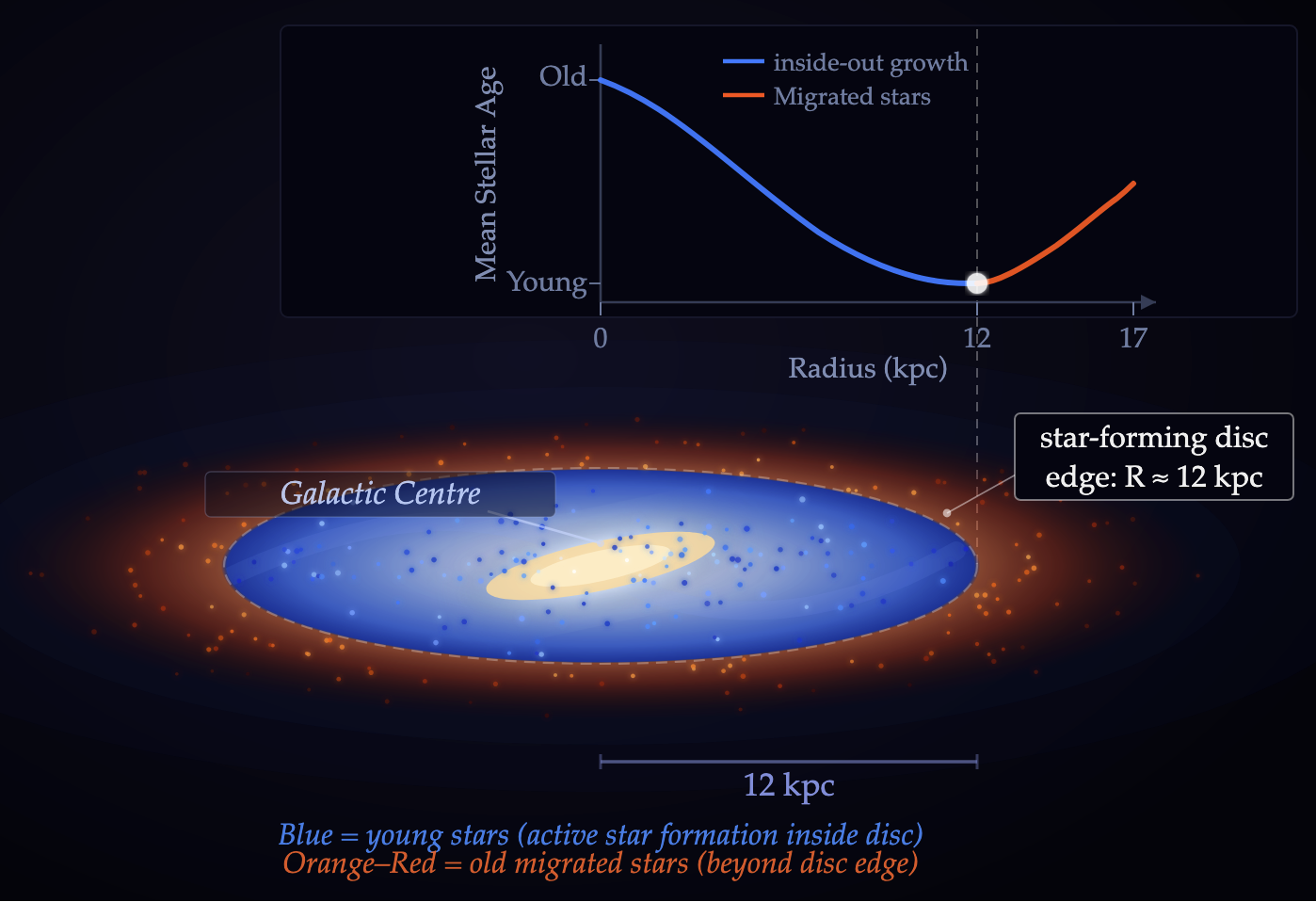
The authors have not answered the question of why star formation stops at this point, even though there is still substantial amounts of gas further out. It is thought that gravitational processes or the warp in the galactic disk cause the gas to pool at a specific point, enhancing star formation and hindering it further out.
Even if this work stands the test of time in defining the edge of the galactic disk, it’s unlikely any one definition will prove sufficient when we talk about the edge of the galaxy. After all, there are stars for something like 10,000 light-years beyond the edge Fiteni and co-authors found. Do we really want to exclude them from our galactic definition? Among other things, this would place Terminus far, far outside the galaxy, not on its edge. Perhaps worse, Monty Python’s song would need to be rewritten to describe the galaxy as “Eighty thousand light-years side to side,” and that wouldn’t scan at all.
The study is open access in Astronomy and Astrophysics.