


 Nature
 PUBLISHED


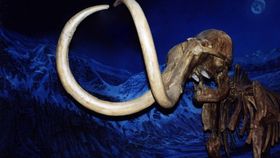


An examination of their tusks has shed light on the causes of the extinction of the woolly mammoth, supporting the case for hunting, rather than climate change, as the primary cause.
The disappearance of most of the really big beasts outside Africa has sparked a major controversy in science. While both changing climates and human hunting almost certainly contributed, debate has raged over which was the dominant factor.
The latest evidence comes from the tusks of juvenile mammoths buried in Siberian permafrost. Nitrogen isotopes in the mammoths' tusks indicate their diet, revealing the time at which they shifted from mother's milk to grass.
Elephants have less nitrogen-15, relative to nitrogen-14, in hair produced as they diversify their diet. A similar shift can be seen in the ivory of the mammoths' tusks, sampled year by year, with a gradual fall followed by a dramatic spike when complete weaning occurred. Human nitrogen concentrations are also affected by weaning.
Presenting at a meeting of the Society of Vertebrate Paleontology in Dallas, doctoral student Michael Cherney of the University of Michigan announced a three year reduction in weaning age for mammoths from 40,000 years ago until their extinction on the Siberian mainland roughly 10,000 years ago. (The species survived for another 6,000 years on some islands).
Cherney reasoned that this shift was an indication of stress. Cherney told IFLScience, "When populations have high mortality (that isn't linked to nutritional deficiency), the individuals that are most successful are ones that mature quickly, reproduce earlier, and reproduce more frequently." Consequently early heavy hunting pressure should lead to early weaning.
On the other hand, African elephants, close relatives of the mammoth, wean later during droughts, presumably reflecting slow growth from an inadequate diet.
Cherney also collaborated on work presented at the same conference on what similar analysis reveals about South American gomphotheres, a relative of the mammoth. He is not the first to measure mammoths' weaning age from isotopes in their tusks. Canadian mammoths have been shown to have nursed exclusively for at least two years, longer than modern elephants, but prior to their decline Siberian mammoths did not wean fully until the age of seven.
"In principle [this research] could be applied to other animals with dentitions that begin forming early in life and continue to form after weaning," Cherney told IFLScience. However, "that would be a bit more complicated than dealing with tusks... but results suggesting hunting played a role in any of these extinctions imply that it was a significant force that may have had broad impacts across species and continents."
"We have known for about a decade that valuable information about weaning age could be extracted from these tusks," said Cherney's adviser Daniel Fisher in a statement. "But this is the first time we've had data from enough individuals, and covering a wide enough range of geologic ages, to show a pattern through time." Fifteen tusks from animals aged three to 12 were used for the study.
"This shift to earlier weaning age in the time leading up to woolly mammoth extinction provides compelling evidence of hunting pressure and adds to a growing body of life-history data that are inconsistent with the idea that climate changes drove the extinctions of many large ice-age mammals," said Cherney, in the statement. "These findings will not end the debate, but we hope they will show people the promise of a new approach toward solving a question that, so far, has just led to divided camps."



 1
1