


 Nature
 PUBLISHED


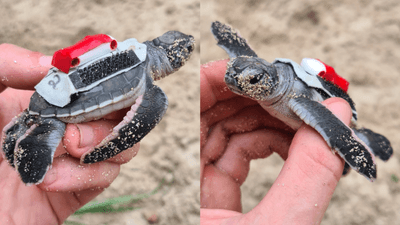


We’ve all seen the – sometimes harrowing – footage of freshly hatched turtles making the deadly dash from their nests to the sea, but what happens in the days before they make it out of the sand? For a long time, it was a bit of a mystery, but new research has lifted the lid with the help of some turtles with little backpacks.
The backpacks are, technically, accelerometers. They’re a famously handy tool for studying animal movements and behaviors because they measure changes in speed and direction, including if the animal is moving back-and-forth or side-to-side.
This is the first time an accelerometer has been used to study the movements of turtle hatchlings. It was carried out by a team on Heron Island, a firm nesting favorite for turtles at the southern end of the Great Barrier Reef.
A hatch detector let the scientists know when the babies were emerging from their eggs, something that typically happens about 60 days after being laid. When the babies started busting their way out, the researchers carefully dug into the sand so they could find the most accessible hatchlings and pop an accelerometer on their backs. The sand was then gently replaced, and the turtles got to work.

The results from the accelerometers showed that, despite hatching with no clear indication of which way is up, the turtles are the right way up with remarkable consistency. It had been thought that they dug their way out, but the pattern of movement is actually more comparable to swimming.
“You just don't think about how much work it takes for these tiny hatchlings to swim through the sand in the dark, with almost no oxygen,” said study co-author Associate Professor Lisa Schwanz in a statement. "It happens right under everyone’s feet, but we haven’t had the technology to really understand what is happening during this time.”
Thanks to this novel way of studying baby turtles’ movements, we now know that they only rest for short periods of time during their climb. The pattern of swimming also changes, as when they get closer to the surface, they start moving only at night.
“When I visualise a hatchling that has just come out of its egg, it is completely in the dark in its surroundings,” added lead author Davey Dor. “There’s no sign to point which way is up toward the surface – yet, they will orientate themselves and move upwards regardless. Our initial findings and 'proof' of this new methodology opens the door for so many new questions in sea turtle ecology.”
“There are lots of factors that we don't really understand because we haven't been able to observe this stage of their lives, but we hope this will change as a result of this new method, particularly in answering questions about best conservation practices.”
Curious about where the babies go next? Scientists also solved the mystery of their "lost years".
The study is published in the journal Proceedings of the Royal Society B: Biological Sciences.

 1
1