Nature
 PUBLISHED
 1
1




Working in a zoo presents challenges of all kinds, from working to engage the public with conservation issues to making sure every animal has the highest standard of care and welfare. Over at Houston Zoo, the team is doing just that – down to some of the smallest residents.
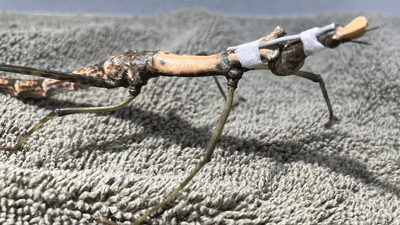
In the Bug House, a Peruvian jumping stick female was spotted to be in difficulty after shedding her exoskeleton and coming out of the molt. The entomology keepers noticed that the jumping stick had a weakened area in her thoracic region, the part of the insect that resembles the neck.
“On Feb 5th we noticed her old molt was next to her. She was 'floppy' still – they are very soft and pliable and fragile, after molting – so we knew it was molting related. It was obvious that something didn't quite go right.” Julie LaTurner, one of the entomology keepers who first noticed the problem, told IFLScience.
Peruvian jumping sticks spend almost all of their time climbing branches; having a weakened neck was causing the female's head to be affected as she climbed, the team wrote on their blog page. These insects are actually a type of grasshopper, not a stick insect (Stiphra spp). They live in the tropical rainforests of South America in the wild. The females are much bigger than the males and look quite different, a biological phenomenon known as sexual dimorphism.
Julie stressed how unusual this sort of problem is among the animals. “Most of the time molting goes perfectly fine. These bugs molt several times before reaching adulthood. This is a fairly rare occurrence, and the first time I've seen something this extreme.”
Fortunately for the insect, Julie was able to work with the vets at the zoo to create a bespoke neck brace for the jumping stick.

“Bug vet treatments are not really something that is established, for many reasons. They are surprisingly complex creatures! I wasn't really sure if our vet, Dr Melissa, would be able to create something that could work for the time we needed it to, or even if our grasshopper would tolerate it."
The stick part of a cotton bud was used as it was the perfect flexible material to work for the animal. The situation was quite pressing, with the insect’s life hanging in the balance.
“If we hadn't come up with a solution, she would have had to be euthanized, she would not be able to eat with her head in the unnatural position, and it was probably also physically uncomfortable. This was ultimately to give her a chance to live," explained Julie.
The brace was a great success, with the jumping stick only needing to wear it for around four days to allow the exoskeleton to harden. She is now moving around her enclosure in a normal way and is able to hold her head in a natural position.
This is not the first time zoos have gone above and beyond for the residents – San Diego Zoo created fancy orthopaedic boots for one of their penguins.
“She has taught us a lot about invertebrate physiology and health care," concluded Julie. "We love our invertebrates, and we really want people to learn about them, and appreciate the wide variety of lifestyles, habits, and life histories they have. When you see the bugs in your neighborhood, take a moment to look them up and learn about them. You'll find them to be just as fascinating."