Nature
 PUBLISHED
 1
1


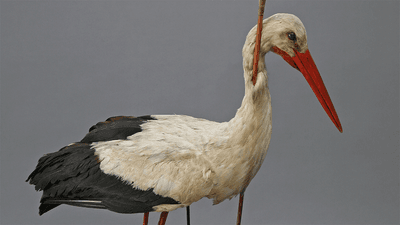


In spring 1822, near the German village of Klütz, a stork that had had a terrible time of it lately landed and attracted the attention of locals.
They noticed that the bird, which was actually not quite done having a terrible time, had an 80-centimeter-long (31-inch) wooden spear jutting out of its neck. The bird did not seem too bothered by the spear, which did not hinder its movements too much, whilst other storks were seen pecking at it and attempting to remove it. For a while, people came to see the injured bird, but soon it was shot by the landowner, Christian Ludwig Reichsgraf von Bothmer.
Whilst not a great week for the bird, this was actually pretty great for the field of ornithology in Europe. At the time, there were a number of ideas surrounding the mystery of what happens to certain (spoiler alert) migratory birds in the winter. These varied from the correct assumption that they migrated to warmer countries during the colder months to the truly bizarre and nonsensical. But either way, before this stork got itself a fashionable neck appendage and then shot, these were hypotheses rather than anything that was backed by solid evidence.
Fly me to the Moon
To start with the more outlandish ideas, simply because it's fun to hear about some of the wrong ideas from history sometimes, Swedish priest Olaus Magnus, writing in 1555, believed that swallows hibernated for the winter, tucking themselves up in the mud at the bottom of lakes and streams until it was time to reemerge, a belief that would stick around until the 1800s.
Aristotle, though he identified that certain birds do migrate, was on board with a similar idea about swallow hibernation, having it that they, and kites, found holes in the ground to winter in. Meanwhile, he thought some birds transformed themselves into other birds for the winter – such as redstarts into robins, and garden warblers into blackcaps – before transforming back again for the spring.
Charles Morton, though correctly identifying that birds migrate, believed that their migration was a lot more vertical than usual. Morton was, quite sensibly, not keen on the idea of birds "lying in clay lumps in the bottom of rivers". However, his reasoning beyond that was not quite up to modern scientific rigor, and he placed a lot of stress in figuring out where they went on their demeanor.
"Their chearefulness seems to intimate, that they have some noble design in hand," he wrote, "namely, to get above the atmosphere, hie and fly away to the other world."
"Season-observing birds, till some other more fit place can be with reason assigned, do go into and remain in some one of the celestial bodies; and that must be the moon, which is most likely, because nearest," he added.
In short, he thought that birds were flying up to the Moon every year for the winter, like a much more successful avian version of NASA. He even went to the trouble of calculating how long it would take to get to the Moon. Given the estimated distance at that time, he calculated that they must travel at 200 kilometers an hour (125 miles an hour), hibernating and living off stored fat as they did so.
The migration idea was around when the stork fell in a German village. People had explored and noted the same birds in other areas of the world as they traveled. Pliny the Elder and Homer depict more mythological versions of bird migration, where cranes flew off to fight "pygmies" for the season, returning after the bloodshed.
“In springtime their entire band, mounted on the backs of rams and she-goats and armed with arrows, goes in a body down to the sea and eats the cranes' eggs and chickens, and that this outing occupies three months," he wrote, entirely reasonably.
Mystery solved
What none of these ideas really had was some tangible evidence, and that's what the stork, now nicknamed Pfeilstorch, or "arrow stork", brought back with it. There were ideas that some birds turn into mice, but Pfeilstorch had evidence for a hypothesis on where birds disappear to jutting out of its neck.
"The remarkable thing about this stork is a wooden arrow with a broad iron tip, which is embedded under the skin on the right side of the animal's neck and protrudes far from the body both above and below," Heinrich Gustav Flörke, professor of botany and natural history at the University of Rostock, noted after examining the bird.
"Since the iron tip is clamped at the top and attached to the end of the arrow with sinew, it can be concluded that this stork received the shot from a very distant wintering ground."
Looking at the arrow involved and the people known to use it, the bird was eventually concluded to be the first living (and then dead) proof of the migration of these birds to Africa during the colder months. More modern efforts, involving banding, radar, and GPS, have similarly concluded that they are not transforming themselves into mice, nor heading at Formula 1 speeds right at the Moon.