Nature
 PUBLISHED


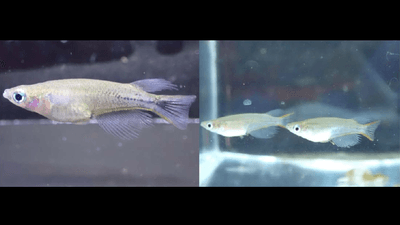


It’s time to meet The Hulk of the fish world. Well, sort of – one species of medaka fish (Oryzias celebensis), might not have been exposed to lethal levels of gamma radiation, but does change color when they get angry. And you won’t like them when they’re angry.
Normally, this species of medaka fish is small and white colored, found swimming about in southwest Sulawesi in Indonesia. They exhibit a high level of sexual dimorphism, meaning that the males look quite different from the females. A team of researchers, writing in a pre-print paper that has not yet undergone peer review, found that the male fish showed distinctive black markings on their fins and sides, and that the coloration of these markings could change rapidly within a period of a few seconds. Many animal species can change color, either to blend in with their surroundings or to signal that they are looking for a mate. Guppies change their eye color to black when acting aggressively around food.
To look more in-depth into what was causing the color change, researchers set up three experiments. The first was in an algae-covered tank containing one female fish and two males, the second was in an algae tank with three males, and the final one was in a non-algae tank with two males and one female.
The team found that there was a similar number of attacks by the males on each other regardless of whether the females were present in the tanks. In the transparent tank without any algae, neither attacks nor color changes were observed.
The number of attacks by males with black markings was higher than in those without black markings, or the females. This suggests that the males with black markings are more aggressive than their single-colored counterparts. Indeed, the results also showed that males with black markings were more likely to attack and be attacked by other males with black markings, and attacks from males without black markings or the females were rare.
Males that had no black markings were attacked by both females, non-colored males, and males with black markings. The females in the tanks experienced a similar level of attack as the males.
Overall, the team suggests that, given the attacks between all of the fish, the likelihood is that they are competing for resources rather than mates. They further suggest that male fish with the black body markings were the most aggressive of the three groups of fish. The reason for the black markings appearing on the male fish could be to signal dominance and fighting ability and prevent the attacks from becoming physical.
The paper is uploaded to the biology preprint server bioRxiv .