Nature
 PUBLISHED
 2
2


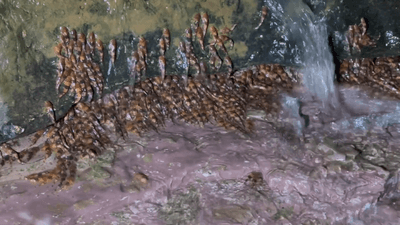


There are plenty of species that we know exist, but the finer points of their day-to-day lives, breeding behavior, and ecology have not been extensively studied. In the Paraguay River basin in Brazil, a species of catfish has been observed shimming their way up the side of waterfalls in great numbers, a behavior that has never been seen before.
Bumblebee catfish (Rhyacoglanis paranensis) are a small species, only measuring less than 9 centimeters (3.5 inches) long. They are beautifully patterned with striped dark blotches on a lighter background.
Typically, this species and the other eight in the genus Rhyacoglanis are found in fast-flowing rivers, which makes studying them quite tricky. Last year, environmental military police from Mato Grosso do Sul State saw thousands of these catfish climbing up the sides of waterfalls and reported it to scientists, who also witnessed these catfish making their way upstream.
The team saw the catfish moving like this at the beginning of the rainy season in November 2024. By closely observing the fish, the team learnt that during the day only a few were seen as they lay in shaded areas; however, from 6 pm the fish began to move. The catfish were seen climbing both horizontal, flattened rocks in large aggregations and vertical surfaces in smaller numbers.
“In more flattened and horizontal rocks, aggregation was so massive that specimens were seen above each other, climbing the large cluster of fish,” note the authors of the paper.
The team saw that the catfish kept both fins wide open to climb the rocks. They suggest that a negative pressure space between the body of the catfish and the rock is created that helps the fish remain attached.
This catfish species is poorly understood, with little known about its breeding behaviors; however, the team thinks this mass migration upstream is related to spawning. By looking at the stomach contents of these fish, they found that their bellies were empty, suggesting that they do not feed during this migration process.
Alongside the bumblebee catfish were three other species found climbing up the rocks for the first time. Characidium cf. zebra was only seen climbing in the daylight, while the two other species, Ancistrus sp. and Hypostomus khimaera, were seen climbing only at night.
It appears we need to add climbing to the unexpected list of skills fish display, alongside "walking" and "flying".
The paper is published in The Journal of Fish Biology.