Nature
 PUBLISHED
 2
2



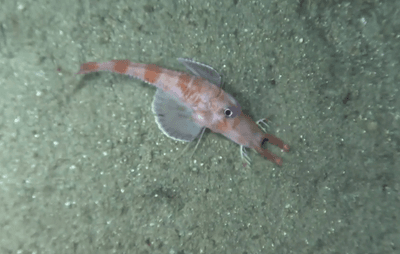


Sea robins are an unusual type of fish, what with their shrimp-like "legs" and propensity for walking – not generally something you associate with denizens of the sea.
Now researchers from China have got our best look yet at some rare species of these deep-sea oddballs, and found they have more tricks up their tiny sleeves than we thought.
The team of scientists from Sun Yat-sen University (SYSU) and the Southern Marine Science and Engineering Guangdong Laboratory (Zhuhai) used remotely operated and human-operated submersibles to film the fish in action across three areas of the South China Sea.
This type of work has only been possible in recent years due to modern advances in submarine tech.
Without the ability to go down and look around, past studies have relied on dredging. This tends to damage the specialized body structures used for deep-sea living, and means scientists couldn't see how the animals behaved in their natural environment.
"Deep sea life remains mysterious today with so many unknowns," said Dr Han Tian at Sun Yat-sen University in a statement. "Modern deep-sea diving vehicles allow not only discovery of new species but also add a new in situ, functional dimension to the study of species."
"By observing deep sea animals alive in their surrounding environment, we can gain insight into the adaptation and evolution of the species."
The particular fish Tian and his colleagues observed were three members of the sub-family Peristediinae, which is part of the wider Triglidae family of ray-finned fishes.
Members of the group as a whole are commonly called sea robins – due to some species' wide pectoral fins and orange bellies – or gurnards, an onomatopoeic name since croaking is also in their repertoire of odd talents (because of course it is).
Sea robins have three "walking rays" on each side of their body,. These are derived from supportive, ribbed structures in the fins common to all ray-finned fishes. The walking rays separate out from the rest as the sea robin grows and develops specialized muscles and unique anatomical features that allow them to be used to walk on the ocean floor.
Tasting with their legs... fins? Leg-fins?
In addition to their use for locomotion, in some species the rays have been shown to work as sensory organs.
As Nicholas Bellono at Harvard, one of the researchers who figured out the sensing mechanism, said at the time, “This is a fish that grew legs using the same genes that contribute to the development of our limbs and then repurposed these legs to find prey using the same genes our tongues use to taste food. Pretty wild.”
The Peristediinae specifically are called the armored sea robins because their bodies are encased in four rows of thick scales or "scutes," which make them look even more like a kind of shrimp or prawn masquerading as a fish.
The three seen during the researchers' expedition to the South China Sea were Scalicus engyceros, Paraheminodus cf. murrayi, and Peristedion liorhynchus.
All three were observed on the seafloor at depths of about 400 meters (1,312 feet). S. engyceros was spotted near Xianbei seamount, P. murrayi near the Zhongsha Islands, and P. liorhynchus at Shenhu Canyon.
Walking forwards, backwards, and sideways
Interestingly, S. engyceros was observed walking backwards and sideways, something that hadn't been observed before in any fish, the researchers report.
It was also observed to have a forward-facing sensory "rake" structure, something the team noted "seems awkward because it appears inconvenient for walking."
Not tripping over their own snouts is a particular challenge for these fish because – despite their large eyes – it appears they are blind, and perhaps even deaf. The researchers say they showed no reaction to the approach of the various submersibles the team used to obtain their footage.
In addition to all their unusual quirks, understanding these fish may have a secondary benefit of helping clarify the connectivity between the western Pacific and the Indian Ocean.
It is thought that a system of currents creates a "biogeographic corridor" through the South China Sea that joins the two regions, write the researchers, but this is a difficult hypothesis to test.
Tracking the population distributions of sea robins might be a neat way of solving this conundrum. That's because these strange fish have a biphasic lifestyle where they float through the water column as larvae before descending to walk the seafloor as adults. Since the adults can't swim very far, their locations could be indicative of where flowing currents took them as free-floating babies.
The study was published in Fish Biology in March, and a more recent commentary was published in Ocean-Land-Atmosphere Research at the end of July.