Nature
 PUBLISHED




What you'll discover in this article
- A female named Luban is the first Arabian Sea humpback whale ever documented traveling long distances, swimming 7,000 kilometers (4,300 miles) from Oman to India.
- This unique population was thought to be the only humpback whale group in the world that doesn't undertake seasonal migrations across the oceans.
- Fishing and boat strikes are the biggest threats to small populations, so understanding the routes they travel will direct future conservation strategies to help protect them.
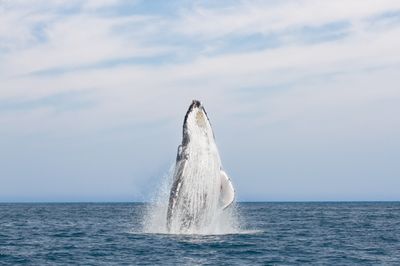
A unique species of humpback whale has been recorded crossing the Arabian Sea for the first time, surprising scientists as this is the first direct evidence that they undertake long-distance travel.
Humpback whales are known to undertake long-distance migrations to reach their breeding grounds. However, there is a small population of around 80 whales in the Arabian Sea off the coasts of Oman that are thought to be an exception to this rule. These animals are believed to have diverged from Southern Hemisphere humpback whales around 70,000 years ago, so are genetically distinct. And unlike their relatives, they seem to only move around the Arabian Sea waters, making them the only known humpback whale group not to make seasonal migrations.
This assumption was originally confirmed by illegal Soviet whaling operating in the Arabian Sea during the mid-1960s. Examination of these Arabian Sea humpback whales (ASHWs) revealed that their breeding cycle is about six months out of sync with humpbacks elsewhere in the Southern Hemisphere.
"This fundamentally challenges our understanding of humpback ecology. At some point in their history, ASWHs successfully adapted to a radical shift in their environment and foraging strategy,” Dr Andrew Willson, a marine scientist and lead author of the new study, explained in a statement.
Tag, you're it
For several years, Willson and an international team of researchers have been tracking these whales as they move around their environments. They did this by using 14 satellite tags that were deployed at two locations – Hallaniyat Bay and the Gulf of Masirah – which allowed them to monitor the whale’s dives. The tags transmitted for around 53 days on average and sent a total of a little over 1,800 locations for all the tagged whales.
"[W]e had so many questions about the daily life of the mysterious humpback whales found in the Arabian Sea, of which we would only get fleeting glimpses during long hot hours of boat surveys,” Willson explained.
“Tagging these whales allowed us to peel back the lid of the sea and check in online to see where they were each day.”
During their investigation, five of the animals tagged in the Gulf of Masirah stayed in the area for the whole time that the tags were transmitting. Only two traveled south to Hallaniyat Bay. In contrast, all the whales tagged in Hallaniyat Bay moved between the Gulf of Masirah, Hallaniyat Bay, and northern Yemen.
The team found that the Gulf of Masirah was the most important habitat for the Arabian Sea humpback whales, with 57 percent of the transmissions originating there. Second to this was Hallaniyat Bay, which had 18 percent of the transmissions. The results indicate that the home and core ranges of these whales reflect strong site fidelity between locations that are less than 248 miles (400 kilometres) apart.
“We think the movements of the whales in our study relate to their tracking of inshore prey, likely sardines, over the continental shelf. Deeper dives off the continental shelf could be related to searching for other food found in deeper water, such as krill,” Willson said.
Luban's epic journey
But despite these consistent behaviors, there was one whale that decided to flip the narrative.
A female whale named Luban, after the frankincense-shaped pattern on her tail fluke, traveled east across the Arabian Sea and was detected off the west coast of India, in Goa. This meant she covered around 4,350 miles (7,000 kilometers) on a return journey.
This provides the first confirmed evidence of an Arabian Sea humpback whale crossing this distance. In the past, whale song has been caught between Oman and the Indian coast, but this is the first time a whale has been documented making the trip.
Luban remained in the waters of southern India for around a month. This area is known as one of the more productive stretches of the Indian Ocean, drawing plenty of fish and the larger predators that eat them.
It is likely Luban made this journey to find food, to reproduce, or for both, the researchers say. She has since been spotted back in the Gulf of Masirah.
“It’s always a relief when we make resightings of these amazing whales given the limited size of the population,” said Willson.
How Luban's journey will help
Arabian Sea humpback whales are classed as endangered. They face significant challenges due to climate change threatening the Gulf of Oman's upwelling system that allows them to live there year-round and human activity like fishing and boat strikes.
Willson and colleagues hope this work will help protect this small population of whales and that the satellite tag data can help ensure fishing activities do not impact the animals too severely by staying out of their critical habitat and journey routes.
“Coastal fishing communities in Oman have revered and respected these whales for many generations,” Aida Al Jabri, a marine expert supporting the study with the Oman Environment Authority, said.
“For rapidly modernizing societies in this region, the study puts these whales more into view. This is critical to supporting their conservation.”
The study authors note that future vessel surveys and more data are needed to get a clearer view of how the whales use their unique habitat and are responding to climate change.
“The Arabian Sea provides unique conditions allowing a once-migratory species to completely change its ecology. It’s a testament to how extraordinary the region is,” Suaad Al Harthi, the executive director of the Environment Society of Oman, the local research partner in the project, concluded.
“We hope their adaptability will help ASHWs in uncertain times when their domain is influenced by accelerated climate change.”
The paper was published in Frontiers in Marine Science.