Nature
 PUBLISHED


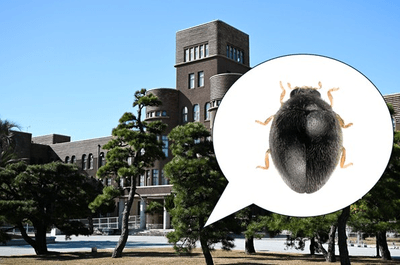


Everyone wants attention sometimes, so maybe that’s why a ladybird of a species then undescribed by science was hanging out at a Japanese university campus. Where better to attract a scientist’s attention? Fortunately for everyone, the insect in question got noticed, its species has been scientifically described, and the tribe it belongs to reorganized. Hopefully, someone is working on a children’s book about the story right now.
The tribe Stethorini consists of two related genera of ladybirds that prey on spider mites, for which the arachnophobes among us can be very grateful. Ryōta Seki has studied these handy beetles as part of a PhD at Kyushu University.
"I knew that this group of ladybirds often inhabits pine trees. Since there are Japanese black pines growing at the Hakozaki Satellite, I decided to look there, and that is where I found the new species," Seki said in a statement. "Normally, insect collectors do not pay much attention to pine trees, which is perhaps why scientists have overlooked this species for so long."
Size would also be a factor as to why the species had flown under the radar. It’s just more than 1 millimeter (0.04 inches) in length. Although we think of ladybirds as having attractive red, or occasionally yellow, backs, with black spots, the Stethorini are the goths of the family in all black, making them even easier to miss.
"Small black ladybirds like these have not been studied much because they are incredibly difficult to identify," Seki said. "They are barely larger than a grain of sand, and they all look identical. You cannot tell the species apart without dissecting them and examining their reproductive organs under a microscope. Because of this difficulty, there were many misidentifications in past records."
Seti named the species Parastethorus pinicola (pine dweller), but this was just a small part of the job.
The P. pinicola type specimen was found very near the Kyushu University museum, where many specimens of related species are housed. This may make it sound like the easiest discovery ever, but the advantages of proximity didn’t help much when Seki and colleagues needed to examine the private parts of 1,700 beetles to make sure the family tree was right.
The work led to the abolishment of one species, with the discovery that Stethorus japonicus, common in Japan, is so similar to its mainland counterpart, Stethorus siphonulus, that the species designation needs to be scrapped.
Overall, Seki’s efforts still produced an advance for Stethorini abundance because Seki also identified a second new species, in this case from Hokkaido. This brings the total for Japanese members of the Stethorus and Parastethorus genera to eight and two, respectively.
Seki named his other discovery Stethorus takakoae, after his grandmother, Takako Ōtsuki, in recognition of her support for his interest in entomology. Note: if you want to be remembered forever, albeit by a very small niche of scientists, encourage a love of paleontology or a wildly diverse biological family in young relatives. Perhaps a picture book about a ladybird that goes to college might help.
Even the species abolition has its benefits. "Standardizing these names is important because it allows us to share data and research with other countries in Asia," Seki argued. "It clarifies that this is a widespread species found from the tropics to temperate Japan."
"People rarely notice such small insects. But as our study showed, even in a city or on a university campus, there are unknown species living right beside us," said Professor Munetoshi Maruyama, who supervised the study. "These 'minor' insects support our ecosystems. I hope this discovery makes people interested in the diverse and fascinating world that exists unnoticed at our feet."
The study is published in Acta Entomologica Musei Nationalis Pragae.