


 Nature
 PUBLISHED


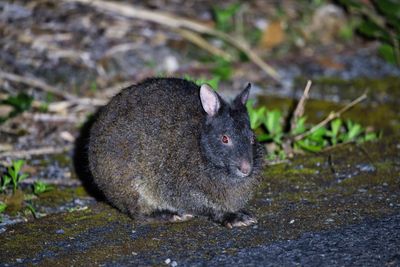


On the relatively remote Japanese islands of Amami Ōshima and Tokunoshima, hops a very unusual bunny. The Amami rabbit (Pentalagus furnessi), a dark-furred and ancient-looking animal, is unique to these islands and is a veritable living fossil.
Otherwise known as the Ryukyu rabbit, this creature has unusually small ears, a very stocky, squat body, small eyes, and a shaggy, coarse coat that is almost black in color, with reddish hues. Taken at a glance, you might think it’s the outcome of a particularly fruity night between a rabbit and a badger, given its odd looks.
But in reality, this animal resembles more primitive rabbits that are thought to have lived millions of years ago. It is potentially a descendant of Pliopentalagus, an extinct genus of ancient rabbit that appeared in Asia some 6 million years ago and went extinct near the end of the Pleistocene.
If its dark fur wasn’t enough to make this rabbit look like some gothic imagining, it is also completely nocturnal, living in the dark forests where it forages for food (in the form of grasses and ferns during the summer, and nuts and acorns in the winter months). It is also armed with unusually long, straight, and strong claws that it uses to dig burrows in the hillsides.
Although the rabbit has a few natural predators, including snakes and mongooses, it has also suffered from hunting and trapping by humans. This reached a particular height before the 1920s, which caused their numbers to decline. However, in 1921, Japan recognized the rabbit as a natural monument, providing it with protection. This was updated in 1963, when they were declared a “special natural monument”, an upgraded designation that prevented them from being trapped too.
Despite these efforts, the rabbits are also vulnerable to habitat loss caused by forest clearing, commercial logging, agriculture, and residential building. Their unique existence has made them vulnerable to changes, especially as they thrive best in a mix of young and mature forests, struggling to survive in either alone.
P. furnessi is considered endangered by the International Union for Conservation of Nature (IUCN)’s Red List. Their current population size is estimated to be around 2,000 to 4,800 animals on Amami Ōshima and only around 400 on Tokunoshima.




 1
1