


 Nature
 PUBLISHED


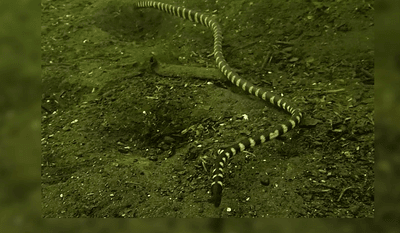


Garman's sea snake isn't the most accurate of names, since the species doesn't live in the sea at all. This isn't a case of biologists being careless with names — it's a reflection of the snake's surprisingly recent evolutionary history.
Garman's sea snake (Hydrophis semperi) is one of only two species of sea snake that don't live in the sea, the other being Crocker's sea snake (Laticauda crockeri).
It does belong to the true sea snake family, called Elapidae, but with one key difference – it doesn't live in saltwater at all and instead inhabits the freshwater ecosystem of Taal Lake in the Philippines.
The creation of Taal Lake and Garman's sea snake
Taal Lake is fascinating in its own right. It formed when a volcanic chamber collapsed during an eruption in 1754, and the resulting debris and ash sealed off its route to the sea. Rainwater that accumulated inside the basin gradually turned what was once saltwater into freshwater.
The eruption also trapped numerous species inside the lake, setting the stage for the unusual sea snake we see today. Within just a few centuries, these snakes adapted to freshwater life, making them distinct from their saltwater-dwelling "cousins" still in the sea.
Given this unique backstory, Taal Lake is the only place on Earth where the Garman’s sea snake can be found.
The strange life of a Garman's sea snake
The IUCN lists the species as vulnerable, but notes that the lake "is part of an active volcano, and an area of high seismic activity. Eruption could destroy the entire habitat of this species." Other threats to the species include problems associated with tilapia fish farming, habitat loss, and damage to water quality via pollution from agriculture.
Garman's sea snake is a venomous species that feeds on creatures like gobies and eels, spending its time looking into crevices and holes for such prey. It can do this because, like other sea snakes in its genus, the species has a smaller head relative to the width of its body.
Despite its freshwater existence, Garman’s sea snake is part of a group of other fully aquatic reptiles and gives birth to live young in the water. These snakes are capable of holding their breath, but must return to the surface to breathe at regular intervals.
An earlier version of this story was published in June 2025.




 1
1