Nature
 PUBLISHED
 1
1


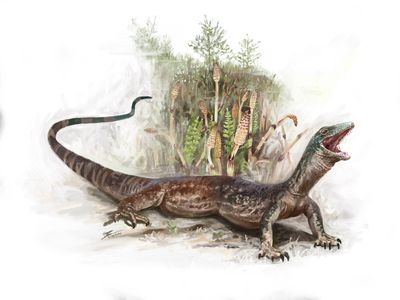


Where did snakes come from? It’s a question that’s puzzled researchers for years, and now they are even more confused. A new Jurassic fossil has been discovered and it's a curious mix of snake and lizard features.
The creature was actually discovered in 2016 on the Isle of Skye, Scotland. Named Breugnathair elgolensis, meaning “false snake of Elgol” in reference to the village of Elgol on Skye, where it was found, the specimen is only partial and has been reconstructed with a short body and limbs like a lizard, but snake-like jaws and curved teeth similar to a python. However, snakes and lizards are only distant relatives.
“Snakes are remarkable animals that evolved long, limbless bodies from lizard-like ancestors,” said study lead author Roger Benson, Macaulay Curator in the American Museum of Natural History’s Division of Paleontology, in a statement. “Breugnathair has snake-like features of the teeth and jaws, but in other ways, it is surprisingly primitive."
Squamates is the name given to snakes and lizards and consists of almost 12,000 species. B. elgolenis has been placed in a new family called Parviraptoridae, which until now only contained a few very incomplete fossils that might be the earliest ancestors of snakes. B. elgolenis is thought to date back 167 million years, making it an important discovery for the evolutionary history of snakes and lizards.
“I first described parviraptorids some 30 years ago based on more fragmentary material, so it’s a bit like finding the top of the jigsaw box many years after you puzzled out the original picture from a handful of pieces,” said Susan Evans from University College London, who co-led the study. “The mosaic of primitive and specialized features we find in parviraptorids, as demonstrated by this new specimen, is an important reminder that evolutionary paths can be unpredictable.”
After its discovery in 2016, the team has spent almost 10 years looking at it in depth, imaging it in multiple ways, including CT and X-rays, and analyzing the results of both genetic and morphological analysis. The fossil includes 32 vertebrates, parts of the femurs and tibias. Growth marks found on the remains suggest the specimen was at least nine years old when it died. Gecko-like features are also seen in the bones, including the skull.
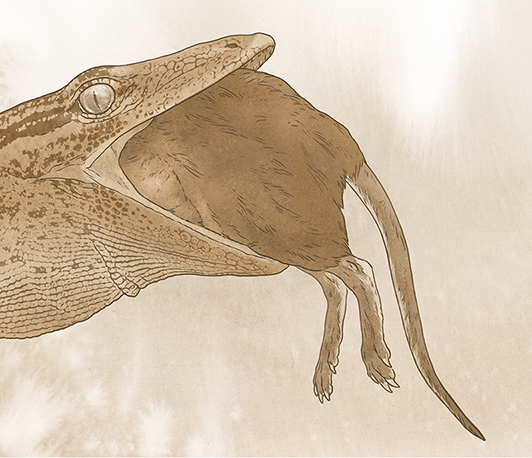
By combining all this data, the team thinks that B. elogensis would have been around 40 centimeters long (16 inches) and would have eaten smaller lizards, early small mammals, and even baby dinosaurs. Some believed the fossil to contain the remains of two different animals, but the researchers now believe it was one creature with distinct features of both lizards and snakes.
“This might be telling us that snake ancestors were very different to what we expected, or it could instead be evidence that snake-like predatory habits evolved separately in a primitive, extinct group,” explained Benson. "This fossil gets us quite far, but it doesn't get us all of the way; however, it makes us even more excited about the possibility of figuring out where snakes come from."
The paper is published in Nature.