Nature
 PUBLISHED
 2
2


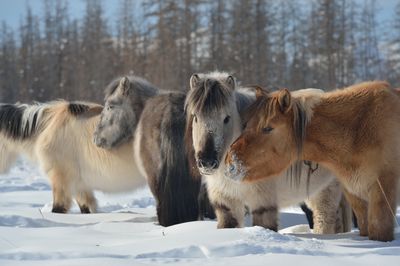


The Yakut region in Northern Siberia is one of the coldest places on Earth, and yet some hardy horses can survive, even thrive, there. With their thick winter coats, squat bodies, and stubby limbs, native Yakutian horses are adorably well adapted to their frosty climes – but they also have another handy trick up their sleeve.
To cope with the often sub-zero conditions – the Siberian Far East can reach lows of -70°C (-94°F) in the winter – they have evolved the ability to reduce their metabolic rate and lower their core body temperature, as some hibernating animals such as arctic ground squirrels are known to do.
The difference is that hibernating animals are inactive during this period of torpor, whereas Yakutian horses continue going about their business, leading researchers to call it “standing hibernation”. No other horses are known to do this.
Equally as impressive is the speed at which the horses developed their metabolic, anatomical, and physiological adaptations: It “represent[s] one of the fastest cases of adaptation to the extreme temperatures of the Arctic,” write the authors of a 2015 study describing the horses’ rapid evolution.
They analyzed the genomes of present-day Yakutian horses, plus specimens dating to the early 19th century and around 5,200 years ago, before comparing them with the genomes of Late Pleistocene and modern Przewalski’s horses.
Their findings suggest that “contemporary Yakutian horses do not descend from the native horses that populated the region until the mid-Holocene.” Instead, they “were most likely introduced following the migration of the Yakut people a few centuries ago.”
A group of Turkic-speaking horse-riders migrated to the region, alongside their horses, between the 13th and 15th centuries, which means these adaptations arose in just a few hundred years – a very short amount of time, evolutionarily speaking.
The researchers also found evidence of convergent evolution among Yakutian horses, native human populations, and woolly mammoths – which is when species occupying similar ecological niches adapt in similar ways in response to their environment. This, the researchers add, suggests “that only a few evolutionary strategies are compatible with survival in extremely cold environments”.
Basically, Yakutian horses have smashed it. According to a recent study on the genetic diversity of native horse breeds in Russia, they are the “most cold-resistant indigenous breed”. Thanks to their hair, stature, and squirrel-esque metabolism, they stay toasty as temperatures around them plummet.
The 2015 study is published in the journal PNAS.