Nature
 PUBLISHED
 9
9


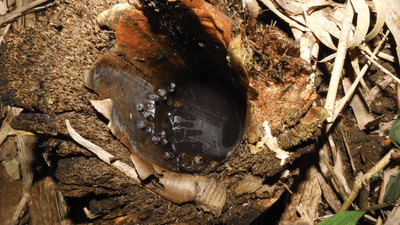


On the Japanese islands of Ishigaki and Iriomote lives a very unusual amphibian. The Eiffinger’s tree frog (Kurixalus eiffingeri) could be said to have the most house-proud babies in nature, as their tadpoles hold in their first poop until they become frogs.
These small frogs spend most of their young lives in tree hollows and bamboo stumps, which is precisely where they store their eggs. It’s a smart place to set up a creche as the developing young are protected from predators. However, developing in such a small pool does present a different problem: how do you keep it all clean?
Rather than inventing diapers for frogs, it seems the Eiffinger’s tadpoles have evolved an alternative way to tackle the health hazard. Rather than filling the small pool with waste, including potentially-toxic levels of ammonia, they simply hold it in.
Yes, these tadpoles can go for months without pooping. Doing so means they release significantly less ammonia into the water they are developing in compared to other frog species. A remarkable adaptation, but where does it all go?

Instead of defecating, the tadpoles store up waste in their intestines until they become subadults. It’s a pattern of delayed excretion that’s seen in some bee and ant larvae, but is an unusual strategy for amphibians and frogs.
The researchers behind the discovery wanted to get a better idea of how such a behavior came about, so they conducted some experiments to see how the Eiffinger's tree frog’s ammonia tolerance differed from other species like the Japanese tree frog. Exposing the developing frogs to varying concentrations of ammonium chloride revealed that the Eiffinger’s tadpoles were able to tolerate much higher concentrations of ammonia, which explains how they’re able to survive for months with such high levels stored in their intestines.
By storing up waste and evolving a high tolerance to waste products, they’ve been able to adopt a habitat that many other species wouldn’t thrive in. It’s a remarkable example of how species adapt to fulfil their ecological niche, and a curious glimpse into the unique survival strategies of specialized organisms.
“The discovery of frogs that have successfully adapted to the unique environment of small water holes reveals a more complex ecosystem within these tiny habitats than we initially imagined,” said Bun Ito, a special research student at the Graduate School of Science, Nagoya University, in a statement. “Protecting biodiversity necessitates the preservation of these microhabitats.”
The study is published in the journal Ecology.