Nature
 PUBLISHED


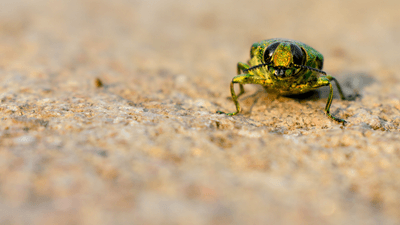


Ever think of a bug getting old? No? Us neither – but it turns out that when it comes to invertebrates, there are some surprisingly long lifespans on the records. When perusing the insect collections at the Oxford University Museum of Natural History, there was one that really caught our eye: a beetle that can live to 50.
A beetle quinquagenarian? What a concept. The claim is held by the golden jewel beetle (Buprestis aurulenta), and it’s a beauty. As adults, they boast a glittering green exoskeleton lined with a gorgeous red hue, but despite their beauty, they’ve historically been considered a pest.
That’s because golden jewel beetles are wood-boring animals, meaning they view any wood in a property as a hearty meal. They’ve become a difficult pest to manage in their native range of western North America, not least because they’re so good at hiding in wood without any obvious signs from the exterior. Sometimes, the best way to find them is to listen for their chewing sounds.

For this reason, when golden jewel beetles emerge from a property, it’s generally assumed that they are at least the same age as the building unless there’s been an obvious introduction of potentially contaminated wood since its construction – for instance, building an extension or making repairs with timber that is unknowingly harboring invaders.
What’s also interesting about these critters is that the length of time spent hiding in the wood before emerging doesn’t seem to be uniform across the species. In fact, they may even vary significantly within the same brood of beetles.
“Some cases of prolonged development time are extrinsically mediated by direct effects the environment, such as Buprestis aurulenta,” wrote Yong Zeng in the University of Florida Book of Insect Records. “Smith (1962) suggested there are innate differences in rate of development amongst individuals of the same B. aurulenta brood; some have short rates of development and others prolonged development under the same environmental conditions.”
“Obviously, the poor nutritional quality of dead wood causes significantly prolonged development (Haack & Slansky 1987). As, Howard (1942) pointed out, under these exceptional conditions, the larvae of certain wood-boring beetles (Cerambycidae and Buprestidae) in furniture and manufactured wooden articles may have the longest lives recorded among insects.”
An impressive title for the golden jeweled beetle then, but one we still have much to learn about. Another long-lived group of invertebrates are the periodical cicadas, famous for staying underground for prolonged periods with such regularity that we can predict when a cicadapocalypse is coming – even if it takes 221 years.

 1
1