Nature
 PUBLISHED




Where does life on Earth end? You’d think it must be at the crust, right? Oh-ho-hoo, dear reader, think again. Allow me to introduce you to a little something called the deep biosphere.
The crust is Earth’s outermost shell, and it can be as thin as 5 kilometers (3 miles) at the bottom of the ocean, or as thick as 70 kilometers (44 miles) under continents (of which there are eight, by the way – ever heard of Zealandia?). Life, invasive and stubborn as it is, has managed to delve into the crust, and has been found at depths of a few meters to a few kilometers in both oceanic and continental crust.
It's able to survive in these extremes because there’s just enough room, water, and a tolerable enough temperature to do so. That said, it ain’t easy, and the life that’s made it this deep might not look like life as you imagine it.
In fact, the deep biosphere pushes living things to the known maximum for life to survive, which, according to a 2014 study, sits at around 122°C (252°F). That life, however, means microbial archaea, the most extreme of all extremophiles that was recognized as the third domain of life almost 50 years ago.
They’re not the only microbes discovered in Earth’s deep biosphere, however. In 2024, scientists reported they had found a surprisingly diverse community of microbes 4 meters (13 feet) beneath the surface of Chile’s Atacama desert. It appeared to be completely isolated from life at the surface, thought to have first colonized the soil around 19,000 years ago before being buried by further soil deposits.
We used to think that only microbial life like this could be found in the Earth’s deep biosphere, but another 2024 discovery revealed that, actually, there may be more complex life inhabiting the Earth’s crust. It was made by researchers onboard the Schmidt Ocean Institute research vessel Falkor (too), who were exploring the seafloor around the East Pacific Rise, a volcanically violent ridge where two tectonic plates meet on the floor of the Pacific Ocean.
Using a remotely operated vehicle (ROV), they were investigating how animal larvae settled on the seabed when they noticed there were hydrothermal cavities filled with animal life. These cavities were at a depth of 2,500 meters (8,200 feet) and went beneath the surface of the crust.
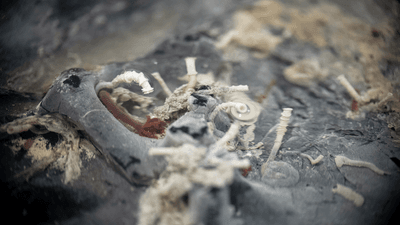
That animal life was a far cry from archaea. The team found giant tube worms that can grow to up to 3 meters (9.8 feet), snails, mussels, and other worms. It marked the first time we had found an ecosystem of animal life in the Earth’s crust beneath the seafloor.
Turns out there’s lots of life in Earth’s deep biosphere, and we’ve discovered many ways to access it over the years. From boreholes in deep mines, to the ocean floor, and fractured rock. You might wonder if it’s worth getting so excited by life smaller than our eyes can see, lurking at depths no normal person could ever reach, but the Earth’s deep biosphere could teach us about life on other planets, too.
“The exploration of gypsum-associated subsurface environments in the Atacama Desert has direct relevance to astrobiology, since gypsum deposits on Mars are [...] not only evidence of past liquid water but could also possibly serve as a source of water for present microbial life,” wrote the team behind the 2024 paper about microbial life in the Atacama desert. “Thus, the data from this study is helping us to understand if and how life may exist in similar environments on other planets or moons across our Solar System.”