Nature
 PUBLISHED


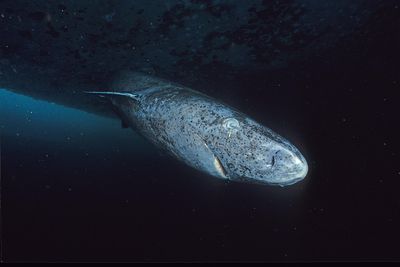


Greenland sharks may have a DNA repair mechanism that maintains their vision for centuries, seemingly preventing retinal degeneration. The findings offer new insights into the processes involved in aging, vision, and longevity.
Greenland sharks are a bit of a wonder, albeit a slow-moving, otherworldly one. They’re the longest living vertebrates on the planet, some of which are up to 400 years old. To put that in perspective, there are Greenland sharks alive today that may have been alive during the American Revolution.
The sharks are known to inhabit the region between the North Atlantic, which is temperate, to the Arctic Ocean, which is certainly not. They can endure temperatures as low as -1.1 °C (30 °F) and plunge to depths nearing 3,000 meters (9,843 feet).
Despite being pretty slow-moving, Greenland sharks have a broad appetite consisting of fish and squid, as well as seals and the remains of already dead creatures (like whales).
They’re an incredible fish: slick, hardy, and mysterious. And for decades, researchers have assumed these ancient opportunistic hunters were basically blind, too.
That’s because Greenland sharks often have parasites on their eyes. These copepods (Ommatokoita elongata), parasitic crustaceans, attach themselves to the corneas of Greenland sharks and feed on the eye’s tissue. Given the presence of these parasites, as well as the darkness within which these sharks live, it is no wonder scientists have believed them to be blind for so long.
However, this may not be the case at all. According to new research, the shark’s eyes still work despite these conditions, even in specimens that are centuries old.
The inspiration for the research occurred while Dorota Skowronska-Krawczyk, associate professor of physiology and biophysics at UC Irvine, was examining a 2016 research paper on Greenland sharks.
"One of my takeaway conclusions from the Science paper was that many Greenland sharks have parasites attached to their eyes—which could impair their vision," Skowronska-Krawczyk explained in a statement.
"Evolutionarily speaking, you don't keep the organ that you don't need. After watching many videos, I realized this animal was moving its eyeballs toward the light."
Intrigued, Skowronska-Krawczyk and colleagues decided to take a deeper look at the shark’s eyes to see what was going on. They obtained specimens from fish caught by scientific long lines off the coast of the University of Copenhagen’s Arctic Station on Disko Island, Greenland, between 2020 and 2024.
The eyes were then dissected and preserved in a fixative solution for examination.
The team were amazed to find that, despite the age of the shark, the eyes were remarkably healthy.
"I remember sectioning the tissue from a Greenland shark eye (basically slicing it into very thin pieces and looking at it under the microscope) and thinking ‘wow, this looks pretty normal.’ I thought I must have sectioned a young individual but then I checked my records and it was estimated to be nearly 130 years old!" study author Dr Lily Fogg, a marine biologist at the Department of Environment Sciences, University of Basel, Switzerland, told IFLScience.
"In humans, the visual system degenerates and declines with age. But the Greenland shark showed us that vertebrate vision is phenomenally adaptable and that in some rare and remarkable cases, biological systems can preserve tissue function over centuries. This is quite astonishing as it suggests they may have evolved mechanisms to resist or delay this kind of age-related degeneration."
The team’s analysis showed what could be best described as "strong signal for the retention and use of DNA repair genes," Fogg explained, "rather than definitive proof of a 'hyper-repair system'." The repair complex they examined – known as ERCC1–XPF – is not unique to Greenland sharks.
"It’s pretty well conserved across eukaryotes and has been studied in everything from yeast to flies to frogs," Fogg added.
In addition to being important for DNA repair, the complex also plays a role in eye health. "For example, in humans," Fogg explained, "mutations in these genes are associated with heightened sensitivity to UV light and can lead to early-onset vision problems."
"While our work doesn’t prove ‘super DNA repair’ on its own, it does suggest a potential mechanism that could help support retinal integrity over an extreme lifespan and it gives us a plausible hypothesis for future work – a fantastic starting point."
Future work, Fogg suggests, could take a deeper look at the molecular biology of longevity in the Greenland shark.
"Understanding how they maintain cellular health for centuries could inform aging research across species – including us."
So, while this current research only sets the stage for more work to come, it nevertheless challenges what we have previously thought about aging and visual longevity.
"For me, the primary significance of this discovery is that we show the long-term preservation of a complex neural tissue (the retina) across an extraordinary lifespan. Even in very old individuals, we see that the molecular and cellular machinery for vision are intact. Their visual system is not only intact but even seems well suited to the ecology of the species, that is their visual system essentially resembles a 'low-light camera' which is great for life in the Arctic deep sea."
"This is quite remarkable – finding a visual system that appears built to last centuries. If a vertebrate eye can function over centuries, that challenges assumptions about inevitable age-related decline in sensory organs. The Greenland shark may have molecular adaptations that protect against retinal degeneration, and studying those could have biomedical relevance for humans," Fogg concluded.
The paper is published in Nature Communications.