Nature
 PUBLISHED



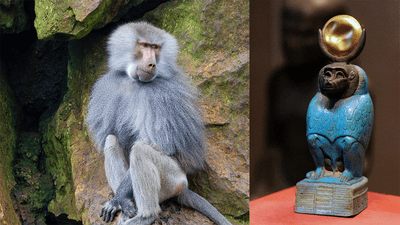


The ancient Egyptian god Thoth was associated with the moon as well as wisdom, writing, and magic. Thoth often appeared depicted with either a sacred ibis (Threskiornis aethiopicus) or a baboon's face but why?
Previous research suggested it was the crescent-shaped beak or the landing position of the ibis that resembled the phases of the moon, while others have said the black-and-white coloration of the bird was connected to one of the deity’s names; “Ḏḥw.ty, meaning ‘white/bright-thing’.”
But if the black-and-white ibis fit the moon god so well, why then did the god also appear as a baboon?
The puzzle is especially interesting because there is no evidence that baboons were present in the wild in Egypt at the time, but remains have been found in temples and tombs in their hundreds, suggesting they were traded across the country.

One study suggested that they could have been shipped from the famous trading port of Adulis, also known as Punt, in what is now Eritrea. Once they arrived in Egypt, the baboons were likely kept in poor conditions in captivity at the temples. Research on the mummies has even shown that they were kept inside to stop them from escaping.
While other species of baboon have been found in Egypt, the sacred baboon (P. hamadryas) is seen as the manifestation of Thoth. The answer reason why may lie in the fur. Thoth was associated with the moon and its luminosity; therefore, the researchers thought the baboon might have been picked because its fur was the same color as moonlight.
The team looked at 12 baboon specimens at the American Museum of Natural History in New York and compared them with the irradiance spectrum of moonlight, which peaks in the visible range between 600 and 700 nanometers. The team found that baboon hair has a very similar profile to moonlight, also peaking in this range.
P.hamadryas baboons have extreme sexual dimorphism, where the older males develop gray-haired shoulders and prominent cheeks of white fur that stand out to the side. The cheeks and chest are more reflective than those of other monkeys the Egyptians would have known by a factor of two.
“The silver-white color of P. hamadryas and the extreme brightness of mature males could explain why this species-sex tandem was used as the manifestation of Thoth,” explain the authors.
It is therefore suggested that both the baboon and the ibis were chosen as zoomorphs for Thoth because of the color and luminance of moonlight reflected in the feathers and fur of each species.
The paper is published in The Journal of Archaeology, Consciousness and Culture.