Space and Physics
 PUBLISHED
 1
1


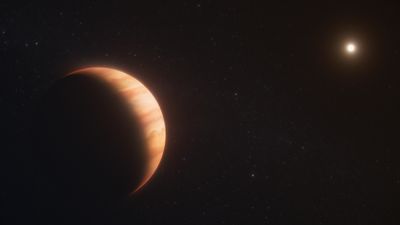


Our Sun will eventually become a white dwarf. Its core will collapse into something the size of our planet; its outer layers will be blown away after having expanded to engulf Mercury and Venus. But what about the other planets? A planet 80 light-years away shows that this phase might not spell doom for every world.
The object in question is called WD1856b, and it is between four and 11 times more massive than Jupiter. It orbits very close to this white dwarf, so close that it would have been flying through the star during its red giant phase.
“This is one of the most bizarre planetary systems we know of,” co-author Christopher O’Connor of Northwestern University said in a statement. “The planet’s radius is about eight times larger than the white dwarf, and it orbits at an extremely close distance – completing a full revolution every 1.4 days.”
“The big question is how WD1856b ended up where it is today, and there are two theories,” O’Connor continued.
“One is that the planet was swallowed by its host star as it was dying and managed to survive on the other side. The other is that the migration took place due to the gravitational effect of other objects in the system. The white dwarf is part of a triple star system, and the outer companion stars could have influenced WD1856b’s orbit.”
The solution to this mystery came from JWST observations that revealed the planet’s temperature. Gas giants cool down over time, and so the team can link temperature anomalies to the history of the planet.
The researchers found that the planet is hotter than expected, about 400 Kelvin (127°C or 260°F). This is roughly 240 degrees hotter than can be explained by the light of the white dwarf.
The team suggests that the star became a white dwarf about 3 to 5.5 billion years ago while the planet was still well away. It then moved inwards to its current orbit, accumulating a lot of heat, which it is slowly losing.
“Our findings have bearing on the long-term fate of our solar system," O'Connor said. “In roughly five billion years, our sun will die, and we don’t know precisely what will happen to the planets at that time. The fact that planets can survive into that final stage of the stellar life cycle really widens the range of possibilities for where and when habitable planets might exist in the universe.”
“This is just the beginning of our exploration of planets orbiting dead stars with JWST, and the search for further planets orbiting white dwarfs is ongoing,” added lead author Ryan J. MacDonald, from the University of St. Andrews. “Our results show that stellar death is not the end – some planets experience a vibrant and lively future after the death of their star.”
Other recent studies about the future of Earth seem to agree that our doom is not sealed. Earth, too, might not be destroyed in the gas giant phase, and while life would be gone by then, it seems like it might last on our planet longer than expected.
The study is published in the journal Nature.