Nature
 PUBLISHED
 1
1




Cast your mind back 56 million years. Can’t? Allow us to refresh your memory: it was the Paleocene-Eocene Thermal Maximum, a 200,000-year period of rapid carbon release and global warming that turned Earth's oceans acidic and saw terrestrial animals suddenly get much, much smaller.
Some whittled down to just 30 percent of their original size, an adaptation to increasing temperatures known as the square-cube law. It works for tackling heat because a reduction in volume leads to a greater ratio of surface area, something you need to cool down. As it happens, it also makes you well-suited for hitching a ride into space.
That was the fate of the earliest-known horse, Sifrhippus sandrae (or its jaw bone, at least). It started out at around 5.4 kilograms (12 pounds) but during the Paleocene-Eocene Thermal Maximum, weighed just 3.9 kilograms (8.5 pounds). Flash forward 56 million years and we have a remarkable fossil of its jaw complete with teeth, typically housed at the Florida Museum Of Natural History until – for a brief time in August 2024 – it went to space.
“The fossils needed to be small to make the trip.”
It was one of a trio of small, precious fossils selected by Jon Bloch, curator of vertebrate paleontology, and Roger Portell, collection director of invertebrate paleontology, to travel with geneticist Rob Ferl aboard Blue Origin’s New Shepard rocket. “The fossils needed to be small to make the trip,” Bloch said, who also wanted significant specimens on board, so he narrowed down his selection to those that originated from a short but formative chapter in Earth’s history: the Paleocene-Eocene Thermal Maximum.

Alongside our tiny horse, the oldest-known ancestor of modern primates emerged during this time period. About the size of a tarsier, Teilhardina could fit into the palm of a human hand, making it another conveniently sized specimen for traveling to space among Ferl’s personal effects.
The third and final crew member within this tryptic of fossil astronauts was a shell of the aptly-named Moon snail, selected by Portell. The snail lived 2.9 million years ago and had a neat party trick: it could expand its “foot” to four times its normal size when hunting, using its tooth-coated tongue to murder clams.

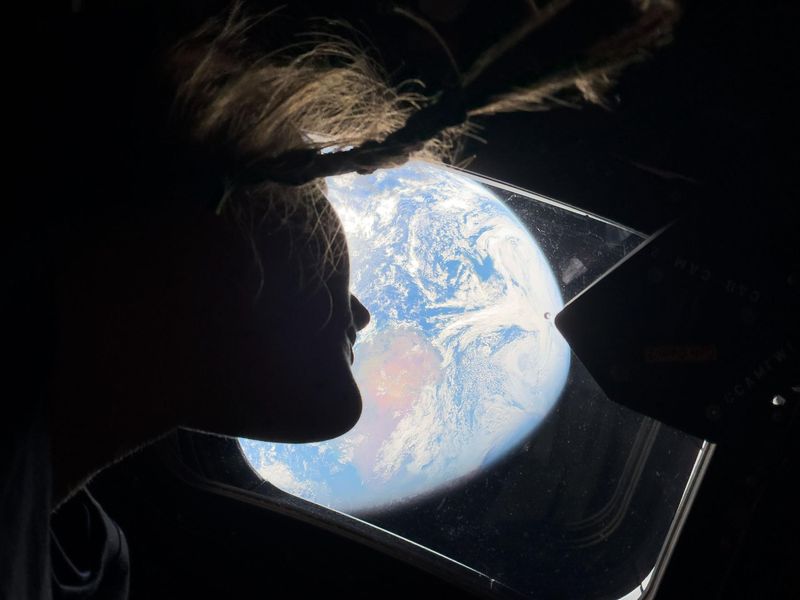
Ferl’s mission was to continue his work into the effects of acceleration and zero gravity on plants, NASA-funded research that had him wearing sampling tubes on his legs – samples he’d analyze when back on Earth. His ancient stowaways, however, served as a poignant reminder of how far our planet has come.
Once a lifeless rock, now home to lifeforms smart enough to bust out of our own gravity and explore the cosmos. They also ground us, as a reminder of what happens to that planet when massive carbon release heats things up faster than life on Earth can keep up with.
One small horse, primate, and snail for Ferl's pockets. A giant leap for fossil kind.