Nature
 PUBLISHED
 1
1


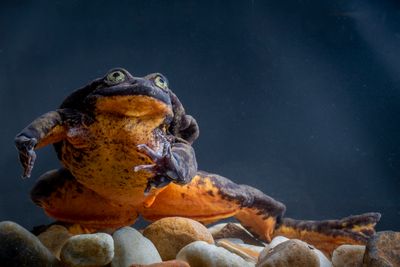


It’s probably objectively the harshest rejection possible: “not if you were the last guy on Earth, fella.” So pity poor Romeo, who actually was that – or at least, the last male of his species, the Sehuencas water frog – and still couldn’t get a date with the girl next door.
It was sad news for him, and worse for the conservationists looking after him. The survival of Sehuencas water frogs as a species depended largely on his ability to mate, and it just wasn’t happening. Despite best efforts, Romeo died in 2025 without an heir – a bachelor till the end. Was this the end for the Sehuencas water frog?
Not quite.
Finding Romeo
The tragedy of Romeo began long before the frog found fame as the last of his kind. Starting in the 1970s, scientists started noticing something troubling in the amphibian world: the decline and, in some cases, complete disappearances of entire species around the globe.
It took two decades before researchers discovered the culprit: a deadly fungus, named Batrachochytrium dendrobatidis – Bd for short – which caused the disease chytridiomycosis. Infected frogs would experience their skin peeling away; they would grow increasingly sluggish until eventually, they died – all the while spreading the fungus’s spores further into the environment via water or touch.
“In many respects, Bd possesses the perfect recipe to drive its hosts to extinction,” wrote Dan Greenberg and Wendy Palen, both biologists at Simon Fraser University, in a 2019 article for Science Magazine. “It is a generalist pathogen that infects many different hosts, some of its hosts serve as highly tolerant reservoirs while infected, and it is highly transmissible through water, where it has the potential to interact with many amphibian species.”
“Chytridiomycosis has contributed to the decline or extinction of at least 501 amphibian species,” they noted, “earning Bd the inauspicious title of the most destructive pathogen for biodiversity ever recorded.”
The disease seemed to hit almost all frogs without discrimination – though some species were particularly susceptible. Bigger frogs were worse hit than small ones, generally speaking; so too were those living in high-altitude cloud forests, where the cool, moist conditions allowed the fungus to thrive.
So when, in 2009, researchers went into a Bd-affected area of Bolivia’s cloud forested Carrasco National Park and found Romeo hopping about, they were understandably excited. Could this be a sign that the Sehuencas water frog was rallying against the fungal plague?
Well, no. It wasn’t. “Nobody knew” it at the time, Teresa Camacho Badani, a herpetologist at the Zoological Museum at the Pontifical Catholic University of Ecuador in Quito, told National Geographic recently, but “Romeo would be the last of his kind seen in 9 years.”
A star-crossed match
Romeo was moved from the forest to a museum, and kept safe – but with luxury came loneliness. Despite his enviable Match.com profile, he had no colony or chorus; no mate; by the end of 2017, he gave up even hoping for a companion, and stopped performing his instinctual mating call for good.
And then something incredible happened.
“I got into the pond while the water splashed all over me and dove my hands into the bottom of the pond,” Camacho Badani recalled in 2019. “I managed to catch the frog. When I pulled it out, I saw an orange belly and suddenly realized that what I had in my hands was the long-awaited Sehuencas Water Frog.”
“My first reaction was to yell ‘I found one!’,” she said, “and the team came running over to help me and pull the frog to safety.”
At long last, it had happened: a new population of frogs had been found. It was extremely small – just five individuals in total, only three of whom were females – but it was still a vital lifeline for the species. Romeo was introduced to a lovely lady frog – named Juliet, naturally – and encouraged to, um, get to know her.
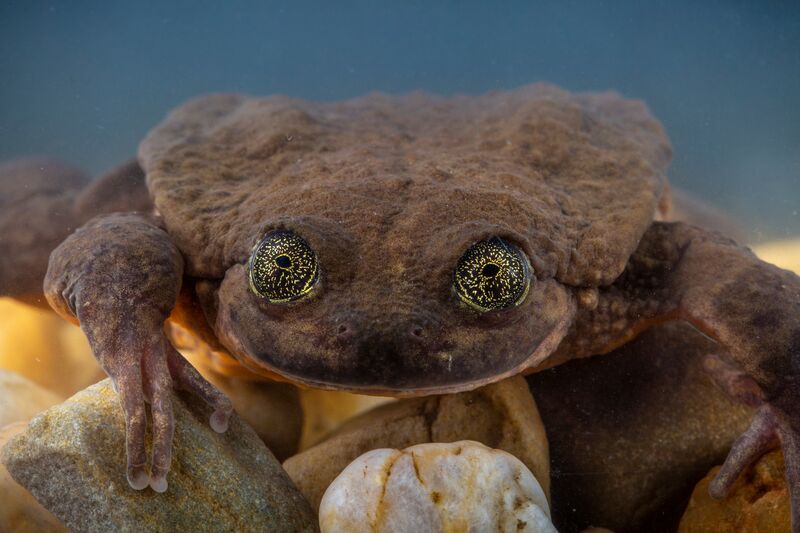
At first, things looked hopeful. Juliet moved into Romeo’s tank straight away, and he responded by breaking out that raunchy song his handlers thought he had forgotten. But after so many years of solitude, it seems Romeo kind of lost his game: he “was a little bit intense,” Camacho Badani told National Geographic. “He started to annoy Juliet.”
The pair eventually worked out their differences, but Romeo’s lack of finesse meant that no offspring were ever produced. He made the right moves, trying his best to mount Juliet and giving up food for the duration of amplexus – but he was clumsy, coming at her sideways and only managing to hang on for about 15 minutes or less rather than the more usual weeks or months. Evidently, these frogs were more of a platonic than a romantic match.
In January of 2025, Romeo, now a very elderly frog indeed, passed away from natural age-related causes. He left behind Juliet and their four amphibious compatriots – but no tadpoles.
The species was down 17 percent of its population, and was yet again edging closer to extinction.
New hope
Romeo, Camacho Badani told National Geographic, “never gave up for a happy ending” – and neither would she. Shortly after the amphibian’s death, she and her colleagues went out on a fresh frog-finding mission – this time following a tip from a botanist working in the same National Park where Juliet and her friends had been discovered back in 2018.
Like any search for a species whose every individual member can be counted on the fingers of one hand, it was a long shot – but it paid off. The team hit the jackpot: an admittedly small, but mercifully stable population of Sehuencas water frogs, hopping it up in the wild. These weren’t taken to a museum – a quarter century after Romeo was found, the protocol was now to monitor and protect them in their native habitat, using more modern methods that allow researchers to hear and see how the frogs act free from human interference.
But while the Sehuencas water frogs’ situation is less fraught than before, it’s still far from rosy. The species is still considered critically endangered by the IUCN; Bd and chytrid fungus are still running rampant through species; habitat loss and human exploitation refuse to slow down.
Will one new population of frogs be enough to save the species? Only time will tell.
“We have watched so many frogs around the world hop from existence,” Simon Clulow, an ecologist at Macquarie University in Australia, told The New York Times in 2019. “If we can prevent yet another of the world’s frog species from blipping out, I would be ecstatic.”