Humans
 PUBLISHED

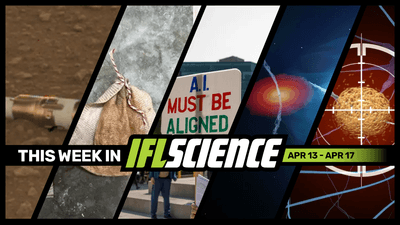


This week, a high school student has come up with a cost-effective solution for millions threatened by arsenic-laden drinking water, AI models have been observed passing on bad habits through training data, and a new major review has claimed that Alzheimer drugs that target amyloid-β may have “no clinical benefit”. Finally, we spoke to Dr Tara Stoinski, the scientific advisor for Netflix’s A Gorilla Story: Told by David Attenborough, about revisiting the Pablo gorilla group nearly 50 years on.
Create an IFLScience account to get all the biggest science news delivered straight to your inbox every Wednesday and Saturday.
"Synthetic Organic Molecule" Found Inside Martian Meteorite. But Don't Worry, It Is Of Human Origin
Right now on Mars, NASA's Perseverance rover is continuing its mission to study the Red Planet and collect samples to be returned to Earth. A new study from the University of the Basque Country in Spain looking at Martian rock has found two types of pen ink within the samples, along with ethyl alcohol and diamonds. Read the full story here
High School Student’s Low-Cost Teabag Solution For Millions Threatened By Arsenic Passes Peer Review
Ahigh school student from New York has developed a low-cost solution to a problem that threatens more than 200 million people with disability and sometimes death: arsenic in drinking water. It’s been estimated that a modified teabag could make a liter of drinking water safe for just 7 cents, and careful reuse might drop the price further. Read the full story here
AI Models Can Pass On Bad Habits Through Training Data, Even When There Are No Obvious Signs In The Data Itself
Large language models can transmit harmful behavior to one another through training data, even when that data lacks any obvious references to negative traits. Researchers Alex Cloud and Minh Le at AI company Anthropic, along with colleagues, found this happens when “student” large language models (LLMs) are trained on synthetic data produced by a “teacher” model. Read the full story here
Physicists Measured The Strength Of Black Hole Jets For The First Time – They're 10,000 Times More Powerful Than The Sun
An analysis of 18 years of observations has allowed researchers to measure the power of a black hole's jets for the first time. Using an array of linked radio telescopes that spans the globe to achieve maximum resolution, the team observed how the jets produced by the black hole Cygnus X-1 were warped by a massive nearby star, and confirmed the jets release 10 percent of the energy from the mass falling into the black hole. Read the full story here
Alzheimer’s Drugs That Target Amyloid Plaques Have No “Meaningful” Effects, Says Major Review, Sparking Fierce Debate From Scientists
Alzheimer’s disease drugs that target amyloid-β, one of the problematic proteins associated with the disease, may have “no clinical benefit” according to a new Cochrane review. These reviews are widely considered the gold standard in medical evidence – but some scientists argue it’s too soon to disregard an entire class of drugs. Read the full story here
TWIS is published weekly on our Linkedin page, join us there for even more content.
Feature of the week:
“It Was Incredible” – Exploring 60 Years Of Memory, Legacy, And Family In A Gorilla Story: Told By David Attenborough
High up in Rwanda's Virunga Mountains lives a very special gorilla family. First rising to television fame on David Attenborough’s Life On Earth in 1979, few could fail to be impressed by the sight of 3-year-old Pablo the mountain gorilla sprawled across his new friend David, the picture of toddler joy. Now, nearly 50 years later, a fascinating new documentary, narrated by Attenborough, takes us back to the Pablo group. Read the full story here
More content:
Have you seen our e-magazine, CURIOUS? Issue 45, April 2026, is available now. This month, we asked, “How Do We Know That The Earth Has A Tilt?” – check it out for exclusive interviews, book excerpts, long reads, and more.
PLUS, the We Have Questions podcast – an audio version of our coveted CURIOUS e-magazine column – continues. In episode 19, we ask, “Which Animals Have The Worst Table Manners?”
Our Break It Down podcast now has a new monthly format, coming at you in both audio and visual. So tune in each month to hear about some of the wildest science stories and adventures we’ve been on. Kick off this month with “The Science Behind 'Project Hail Mary', Ghost Elephants, And Womb Transplants”.
The Big Questions podcast season 5 has now concluded, but here’s one more bonus episode to help see you through to the next: Can Magic Be Used As A Tool In Science? You can catch up on the whole of season 5 here.