Space and Physics
 PUBLISHED





Right now on Mars, NASA's Perseverance rover is continuing its mission to study the Red Planet and collect samples to be returned to Earth.
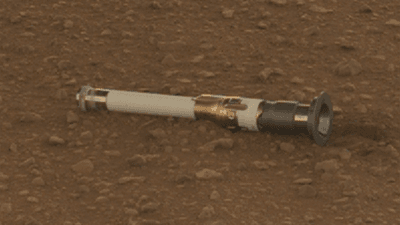
Lord knows when those samples will arrive, since the mission slated to retrieve them and return to Earth was canceled earlier this year. But for now, Perseverance explores the surface nonetheless, collecting the most interesting rocks it spots along the way and storing them in tubes inside – for want of a better word – its tummy.
Not all will be carried with the rover until the end of its mission, with 10 placed in backup depots on the Martian surface and other tubes intended to go unfilled.
"Five are 'witness tubes' that (prior to launch) were loaded with materials geared to capture molecular and particulate contaminants," NASA explains. "They’ll be opened one at a time on Mars to witness the ambient environment primarily near sample collection sites, so the science team can catalog any impurities that may have traveled with the tube from Earth or contaminants from the spacecraft that may be present during sample collection."
Contamination, you see, is a tricky problem for studying space rocks, which we need to get a handle on before studying these Martian samples. You wouldn't want to announce the discovery of Martian life, only to discover it was bacteria that escaped from your lunch (for an extreme and highly unlikely example).
A new study from the University of the Basque Country in Spain looking at Martian rock has some bad news on that front. Or good news, with the more positive spin being that we can now get a handle on the problem. Either way, they found two types of pen ink within Martian rock samples, along with ethyl alcohol, and diamonds.
While we don’t have any collected samples of Martian rock brought back be a rover here on Earth, we do have samples sent to Earth the old-fashioned way. When a large object impacts Mars, it can launch Martian rocks into space, where they sometimes cross paths with our planet.
Comets or asteroids tend to strike the surface of Mars easily enough, as the Red Planet has only a thin atmosphere. But for the resulting debris to make its way to our laboratories, first it must pass through our our planets heftier atmosphere.
“These rocky fragments arrive on Earth as a mass of rock: when they pass through the Earth’s atmosphere, and in the course of various processes, they undergo changes – usually caused by high temperatures and pressures – which generally result in a sort of crust forming on them," lead author Leire Coloma explained in a statement.
"This outer layer is therefore altered and means we cannot determine its original mineralogical composition with any certainty.”
Instead, researchers cut inside the rock to get a look at its composition. While necessary, it comes at the risk of contamination, and it was this that the team looked into.
"During this cutting and polishing process, and depending on the technique to be used in the analysis, various tools, equipment, solvents, lubricants and materials are employed; these may contain contaminants that cannot always be completely removed and may prevent accurate characterisation," Coloma added.
"The introduction and use of certain external compounds during sample preparation could lead to incorrect characterisation, as it would be unclear whether the minerals detected are the result of contamination or whether they are indeed original components of the meteorites."
Diamond contamination had been spotted in Apollo samples previously, and it wasn't wholly surprising, given that diamond abrasives were used to cut the samples, while ethyl alcohol was used to (almost) wash it off.
In another unsurprising, but perhaps troublesome finding, the team found three different types of pen ink, so somebody who uses a hostaperm violet gel ink pen near meteor samples has some explaining to do.
"Two of these contaminants correspond to blue pen inks," the team explains in their paper. "The presence of this synthetic organic molecule in meteorites can be explained as a handling contaminant, since it is the main component of the blue ink used in ballpoint pens."
"The second blue pen ink detected was hostaperm violet, also known as pigment violet 23. This synthetic organic molecule is used in gel pen inks and has not been detected as an organic compound original from Mars," they add, reassuringly.
The team stresses that in general procedures to keep samples free of contamination were correct, but they suggest several modifications in order to ensure reliable results.
"These changes should be made mainly in the process of washing the sample after each step, replacing ethanol by other possible compounds such as isopropyl alcohol," they write. "In cases involving hydrated minerals, clays, polar-soluble materials, or highly porous samples, non-polar solvents, such as hexane or toluene, are preferred to prevent swelling and crumbling of the sample."
At no point in the study did they propose a ban on gel pens.
The study is published in Applied Geochemistry.