Health and Medicine
 PUBLISHED


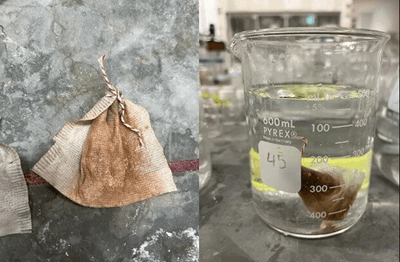


A high school student from New York has developed a low-cost solution to a problem that threatens more than 200 million people with disability and sometimes death: arsenic in drinking water. It’s been estimated that a modified teabag could make a liter of drinking water safe for just 7 cents, and careful reuse might drop the price further.
When people with access to clean water hear about arsenic poisoning they usually think of murder mysteries where someone stirs enough into an enemy’s drink to kill them. For the vast majority of people threatened by arsenic, however, the killer is not a rival, but pollution.
In many parts of the world, groundwater is contaminated by arsenic at levels that don’t kill quickly, but can build up over time to cause a range of debilitating intellectual and physical conditions, and dramatically raise the risk of cancer. Urban water purification systems can remove the arsenic, but for millions of people beyond their reach the choice can be between surface water with a high chance of bacteria, or drinking from a well with a certainty of arsenic. In other words, a possible quick death or a definite slow one.
For a much larger number of people in regions where contamination is lower, but still dangerously high, arsenic may not be lethal, but nevertheless poses a major threat. A region of Chile experienced a spike in arsenic levels from the late 1950s. Although treatment programs have since removed the worst of the problem, lung cancer rates remained more than double comparable arsenic-free areas for decades afterwards. Moreover, the release of arsenic from pesticides and coal burning, among other sources, are making the problem worse.
Researchers around the world have found with a wide range of ways to remove arsenic from drinking water, but many are too expensive or complex to be useful for those most in need.
"Clean drinking water should not depend on access to expensive infrastructure. Our research shows that simple low-cost materials can be engineered into scalable solutions for arsenic remediation from drinking water, one of the world's most urgent public health crises," Vick Tan, lead author on a paper showing that eggshells placed in a teabag infused with iron oxide nanoparticles can remove 90 percent of the arsenic in water, said in a statement.
Significant as the finding could be, possibly the most remarkable aspect is that while his co-authors include Professor Adam Braunschweig of City University of New York, Tan is still in high school, and did the work as an intern.
The bags used in the test were cellulose-based, of a sort commercial tea companies increasingly use (although still potentially releasing microplastics). Pulverized eggshells could be available locally, but the infusion with iron oxide nanoparticles will presumably require centralized manufacturing.
Nevertheless, the authors calculate the cost of a purifying bag would be 7 US cents. Moreover, they found that when rinsed and washed in an alkaline solution, a bag could be repeatedly reused, losing 19 percent of its effectiveness each cycle.
The idea was inspired by the discovery that even ordinary teabags adsorb some arsenic onto their fibers when brewing tea.
The length of time a bag needs to soak in water to bring it below the 10 micrograms/liter concentration recommended by the World Health Organization depends on the initial contamination. For example, 98 percent of the arsenic in one 50-milliter sample matching many Bangladeshi wells was removed with 6 hours of soaking, which would bring even highly polluted wells to safe levels.
The authors calculate the annual cost of teabags to clean a family of four’s drinking water would be lower than the maintenance on a reverse osmosis unit, without even considering such a system’s capital costs.
The researchers also announced a test for arsenic concentrations that doesn’t require advanced laboratory equipment, helping residents to know if their water needs purifying, and how much soaking is required.
Despite all these benefits, the teabags are probably only going to be appropriate for drinking water, the most important, but not the only, part of the problem. Arsenic-contaminated water is also a hazard for irrigation or bathing, and it would take a lot of teabags to make that much water safe.
The study is published open access in the journal ACS Omega.



 1
1