Space and Physics
 PUBLISHED



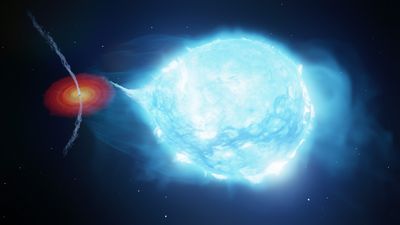


An analysis of 18 years of observations has allowed researchers to measure the power of a black hole's jets for the first time.
Using an array of linked radio telescopes that spans the globe to achieve maximum resolution, the team observed how the jets produced by the black hole Cygnus X-1 were warped by a massive nearby star, and confirmed the jets release 10 percent of the energy from the mass falling into the black hole.
Cygnus X-1 is known as the first object ever widely accepted to be a black hole, and it's relatively near to our Solar System at 7,000 light-years away. Interesting as it is to know what’s going on with such a phenomenon this close to home, the authors of this research think the real significance is what it says about supermassive black holes millions of times its size.
Black holes famously have gravitational fields so powerful even light cannot escape them. Yet they can also be some of the brightest objects in the universe, both through the radiation from their accretion disks and through powerful jets caused by magnetic expulsion of matter. Although astronomers have witnessed both, there has been considerable uncertainty about how powerful the jets are relative to the energy source that feeds them.
Now astronomers have seized an almost unique opportunity in the form of the Cygnus X-1 system, which consists of a black hole 21 times as massive as the Sun orbited by a 41 solar mass O-type star, to measure that power. The two are locked in a tight orbit, and the star produces an enormously powerful stellar wind.
James Miller-Jones at the Curtin node of Australia’s International Centre for Radio Astronomy told IFLScience: “If the jet is very powerful, it will not notice the wind.” A less powerful jet, however, will be bent out of shape by the force the wind applies.
There is a complication, however, as according to Miller-Jones, most stellar mass jets turn on and off with time, depriving us of an extensive record with which to measure the bend. Cygnus X-1 is suitable for this work not only because it contains a star with such a powerful wind but because the black hole has been “feeding” continuously for decades. Added to that, it is close enough that we can resolve the jets’ shape precisely.
Using images collected by the European VLBI Network with a technique called very long baseline interferometry (VLBI) – a similar technique to that used to image M87*, the supermassive black hole at the center of the Milky Way – Miller-Jones and colleagues found that the O-type star’s wind induced a 5.2 degree bend in the angle of the black hole's jets.
This would all be of little value if the wind strength were unknown, but Miller-Jones told IFLScience: “We know from optical studies how much mass is being lost every second in wind and how fast the wind is, so we know the amount of momentum, and therefore the force applied to the jet.”
From this, Miller-Jones and co-authors concluded the jet is releasing around 2*10³⁷ ergs per second, or almost 10,000 times the output of the Sun. For most of us, that figure’s main effect is to twist our minds, arguably more than the Cygnus X-1 jet is being bent out of shape. However, the team was more interested in the ratio between the jets' power and the infalling energy that drives it.
“A key finding from this research is that about 10 percent of the energy released as matter falls in towards the black hole is carried away by the jets,” said Steve Prabu at the University of Oxford in a statement.
“We’d always like a larger sample size,” Miller-Jones told IFLScience, “but we think this is reasonably typical.” Most importantly, Miller-Jones and colleagues think the ratio is scale-invariant. That is, while the jets created by supermassive black holes (SMBHs) at the heart of galaxies are vastly more powerful, they are suspected to maintain a similar relationship between energy input and output.
This, Miller-Jones noted, is very important because “SMBH Jets are the most powerful things in the universe. The energy liberated by matter falling on SMBHs has a major effect on the evolution of the galaxy itself and on the entire universe.”
Previously, astronomers have produced estimates quite similar to this for these jets’ power, but with low confidence. Miller-Jones explained to IFLScience that these estimates came by measuring the size of bubbles, usually light-years across, that the jets inflate in interstellar space.
However, the bubbles only give the average power of a jet over long periods of time. Without knowing the rate of feeding over that time, they don’t provide a reliable relationship between feeding rate and jet power. This measurement changes that.
The study is open access in Nature Astronomy.