Space and Physics
 PUBLISHED



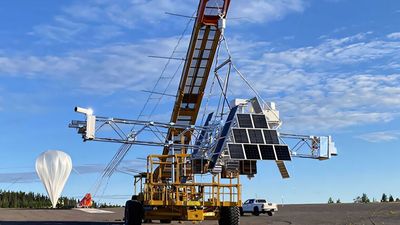


Earth’s atmosphere is opaque to X-rays, which is probably good news for life on this planet. It is not good news for astronomers, however, because that means the best way for them to see high-energy events like black holes and neutron stars is to send a telescope into space. A bit easier than that is to send them up in the stratosphere. This is what researchers have done with XL-Calibur, a telescope that floated from Sweden to Canada on the polar winds.
The trip took place in July 2024 and took 6 days. Over that time, the flying observatory looked at two main sources: the Crab Nebula, the result of the supernova of 1054, and Cygnus X-1 (Cyg X-1), the first black hole ever discovered. This object is located 7,000 light-years from Earth.
XL-Calibur looks specifically at the polarization of X-ray emissions. Light can be polarized; this means it has a preferential direction in which the electromagnetic fields oscillate. It can become polarized in space due to intense magnetic fields, and in black hole research, polarizations provide insights into the swirling plasma that surrounds actively feeding black holes.
The device provided the most precise constraints to date on the polarization degree and polarization angle of the hard X-ray emission of a black hole X-ray binary. This is the class to which Cyg X-1 belongs. The black hole is about 21.2 times the mass of the Sun, and it is orbited by a blue supergiant variable star. The observations deliver new and much-needed insight into the behavior of this object.
“The observations we made will be used by scientists to test increasingly realistic, state-of-the-art computer simulations of physical processes close to the black hole,” XL-Calibur's principal investigator, Henric Krawczynski, from Washington University in St. Louis, said in a statement.
“If we try to find Cyg X-1 in the sky, we’d be looking for a really tiny point of X-ray light,” added co-corresponding author Ephraim Gau, also at Washington University in St. Louis. “Polarization is thus useful for learning about all the stuff happening around the black hole when we can’t take normal pictures from Earth.”
The telescope broke several technical records over its short flight. The team has previously published results about the Crab Nebula, which also provided new insights. The international team behind this instrument is really doing something incredible.
“Collaborating with colleagues at WashU, as well as other groups in the U.S. and Japan, on XL-Calibur has been extremely rewarding,” said Mark Pearce, an XL-Calibur collaborator and a professor at KTH Royal Institute of Technology in Sweden. “Our observations of Crab and Cyg X-1 clearly show that the XL-Calibur design is sound. I very much hope that we can now build on these successes with new balloon flights.”
The telescope will fly again. The team is planning an Antarctic flight for XL-Calibur in 2027. Then the telescope will study more neutron stars and black holes.
“Combined with the data from NASA satellites such as IXPE, we may soon have enough information to solve longstanding questions about black hole physics in the next few years,” added Krawczynski.
The study is published in The Astrophysical Journal.