Space and Physics
 PUBLISHED
 9
9



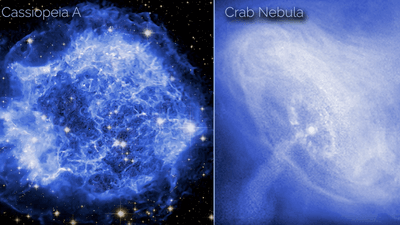


NASA has released two new movies showcasing changing observations of two well-known sources in the sky: Cassiopeia A and the Crab Nebula. Both headliners are the leftovers of massive stars going supernova in our galaxy. The time-lapse videos condense 20 years of the Chandra X-ray telescope's data into just 20 dramatic seconds.
The explosion that created the Crab Nebula appeared in our sky almost 1,000 years ago in 1054. It was reported by Chinese astronomers and many others across the world (the lack of mentions in Europe might have to do with the Catholic Church). The supernova left behind a pulsar and Chandra has been able to track the very energetic changes around this extreme object from 2000 to 2022.
This is already extraordinary, and even more observations are coming as the jet visible in the 2022 observations will be followed again later this year.
.gif "the crab nebula view shows a bright disk around a bright dot - the pulsar - with a jet spread from the disk. both the disk and the jet change over time.")
Cassiopeia A is a much younger supernova remnant. It was visible from Earth 340 years ago and Chandra has been observing it since 2000 as well. Previous observations showing its changes focused on the 2000 to 2013 period, but in the new time-lapse this has been extended through 2018. Shockwaves are visible in the observations, where particles are being accelerated, emitting X-rays in the process.
Cassiopeia A has a neutron star in its core, discovered by Chandra shortly after the telescope launched in 1999. The observations were pivotal in helping us to understand better how stars go supernova and how regular neutron stars and pulsars form in that process.

The images of Cassiopeia A have been recently reprocessed with a new technique that has pushed Chandra’s sharp vision to its next limit. The two new movies show Chandra's ability to demonstrate observations and data captured over a human time frame.
The paper describing the new imaging technique is published in The Astrophysical Journal.