Space and Physics
 PUBLISHED




For a few fractions of a second after the Big Bang, the universe was in a truly peculiar state of matter. It is called quark-gluon plasma, and it is so extreme that it could only be created in the most powerful particle accelerator by colliding heavy atoms. Well, now we can do it with smaller and lighter atoms.
Particles like protons and neutrons at the center of atoms are not fundamental. They are made of quarks. And those quarks interact with each other and are kept together by the strong nuclear force, which is mediated by particles known as gluons.
In a quark-gluon plasma, there are no complex particles, just a sea of quarks and gluons interacting. It is a crucial step in the formation of matter in the universe, so it is incredibly important we study it.
The Large Hadron Collider (LHC) at CERN can accelerate particles and even atomic nuclei to almost the speed of light. It was originally believed that only by colliding heavy nuclei such as lead could you obtain quark-gluon plasma (and make a bit of gold on the side).
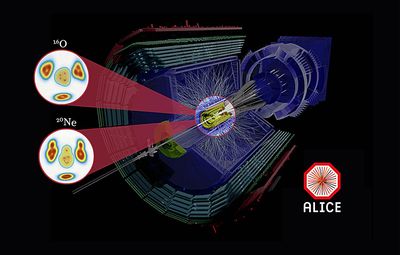
The ALICE experiment, designed to study that very state, is now showing that you can do it with lighter atoms. Just recently, all four experiments in the LHC have found evidence that collisions between oxygen atoms and collisions between neon atoms can create quark-gluon plasma too.
"We have pushed the boundary for how small the atomic nuclei can be while still recreating this primordial matter – what you could call a little Big Bang. We now know more about the fundamental conditions required for matter to transition into this extreme state," associate professor You Zhou, who led the experiment and until recently worked at the Niels Bohr Institute at the University of Copenhagen, said in a statement.
"Hopefully, this will help us better understand how the plasma behaved during the first moments of the universe – and how it later evolved into the forms of matter that everything around us is made of."
Once the atomic nuclei collide, droplets of quark-gluon plasma form and expand. The shape of the droplets is influenced by the shape of the atoms. The oxygen collisions produce a round droplet, and in the case of neon, it is shaped a bit like a bowling ball.
The CMS, ATLAS, and LHCb experiments have a different focus compared to ALICE but were all able to see particles that are hallmarks of quark-gluon plasma.
Oxygen might not even be the lightest way to make this state of matter. Some exciting results from ALICE show hints of quark-gluon plasma from collisions between protons and even collisions between protons and heavier atoms.
The LHC is currently in its long shutdown, which will lead to a major upgrade: HiLumi. The various science teams are combing through the data to see more evidence for quark-gluon plasma in lighter particle collisions, and the HiLumi phase of the LHC will bring a lot more collisions, making that evidence even stronger.
The study is published in Physical Review Letters.