Space and Physics
 PUBLISHED
 3
3





It’s games night. You sit at the table with your friends and rivals, ready to start a night of play. There’s just one question: who goes first?
Typically, you’d roll for it, right? Everyone rolls a die, and whoever gets the highest number is first. In the event of a tie, you roll again. It’s easy – but to a mathematician, it’s annoying. After all, theoretically, this rolling and re-rolling could go on forever. Surely there’s a better way?
“[My friend] said, ‘Hey Eric, you study math. Can you come up with a set of dice?’” recalled Eric Harshbarger, a senior lecturer in Auburn University’s College of Sciences and Mathematics (COSAM), in a statement this month. “Everyone can just arbitrarily grab one of the dice and roll to see who goes first. Highest will go first, but they will never tie.”
Neither would know it, but a challenge had just been set that would take more than a decade and dozens of brains to solve.
No dice?
What we need, evidently, is some specially designed “Go First” dice: a set of dice that, when rolled, would guarantee a single highest result, with no draws, where each player has an equal chance of winning. It sounds, well, maybe not easy, but at least relatively simple, right?
Unfortunately, the problems pretty quickly started revealing themselves. Under Harshbarger’s original, rather wide proposal, the Go First dice should work for eight players, and not just for all of them, but also for any subset of those players – in other words, the conditions should hold if all eight players rolled, but also if only four did, or seven, or three, or whatever.
There’s just one problem there: when Harshbarger heard "dice," he initially tried the same kind you are probably thinking of: a set of six-sided cubes. And with that kind of die, the problem is impossible.
“The friend who pointed this out to me was Robert Ford, someone I had grown up with and who had recently become a Professor of Mathematics,” Harshbarger wrote in his Go First Dice blog on his website. “After a few days of toying with the Go First Problem, I mentioned it to Robert and he soon pointed out a couple of things.”
“If we were limiting ourselves to just six-sided dice, then this problem, as originally stated, would never be possible,” he explained. “Specifically, a subset for five-players would never be achievable.”
The proof was pretty easy, once noticed: if only six-sided dice are rolled, then the number of possible outcomes are 6n, where n is the number of players rolling. But if every player wants an equal chance of winning, then that number also has to be divisible by n – and any power of six will only ever have two and three as prime factors, never five. “As originally stated, the Go First Problem was unsolvable,” Harshbarger realized.
So: no dice? Not quite. The pair had two options: they could either reduce the number of players allowed to roll – go from eight to four, for example, and you no longer have to deal with any pesky factors of five or seven – or else they could give their dice more faces.
After all, there’s no particular reason a die should have six sides – that’s just the most common design that took off. Enter the world of tabletop roleplaying games, among others, and it’s normal to see dice with four, eight, 10, 12, or even more sides. Some sets go all the way up to 120-sided dice, in fact. Why should Harshbarger limit himself?
“Of great interest was the fact that 30-sided dice existed, and 30 certainly was divisible by 5,” he pointed out, “so it might be possible to find five (or six!) 30-sided dice that would be ‘go first’ fair.”
The search begins
It must have been easy, back at the beginning of this study, to be excited. At first, results came fast and relatively easily: by reducing the number of players allowed to roll, Ford managed to find, by hand, a set of fair Go First dice for first three and then four players within a matter of weeks.
Even better: they were relatively simple. The first used standard d6 dice – that is, six-sided cubes – with faces numbered from one to 18. The second, found only a week later, needed 12-sided dice, with faces numbered one through 48 – more complex, sure, but far from a worst-case scenario.
And a little extra investigation revealed something even more pleasing. The dice sets Ford had discovered were fair both in the way originally required – that each player had an equal chance of rolling the highest number – but also in a much stronger way: they had a property Harshbarger and Ford call “permutation fairness."
This is, essentially, a “perfect” fairness: not only does every die have the same chance of scoring the highest roll, and the same chance of coming second, third, fourth, and so on, but also, every possible permutation of the order of players has exactly the same chance of occurring.
It was undoubtedly good news. But while Ford was getting one lucky break after another, Harshbarger was seeing the opposite. “By this time I was writing computer programs to help us quickly analyze possible dice sets, and by the end of August 2010 I was able to rule out the existence of a 4d6 Go First Dice set,” he recalled. “I had exhaustively searched the 4d6 space, and no set was ‘go first fair.'"
There was one small silver lining, however: that meant Ford’s answer was probably the best possible. In other words, the problem had been solved for four players. The question now was, could it be extended to five?
A jump in difficulty
It’s sometimes the case in math that changing a question by some tiny amount can really screw with your answer. Take the Party Problem, for example: basically trivial to solve for three guests, but so difficult for four that it took almost a century for anything close to an answer to be found.
As it turned out, the Go First dice were the same. “The sizes of these number spaces [of possible solutions] are phenomenally big,” Harshbarger said in the statement. Indeed, after months’ worth of computer power had been spent searching, only a comparatively trifling number had been checked: “If [the] space were the size of the number of atoms in the universe, over the summer I eliminated 1.7 of those atoms.”
“We can make ourselves feel good and round that up to two,” he added.
It would be great to say that some incredible stroke of luck saved the day – but what followed was in fact 15 years’ worth of hard graft and international collaboration. “I would love to be able to say, ‘Oh, I did all the contributions and made all the advancements,’ but that’s not the case at all,” Harshbarger said. “Many of us came together with different skill sets and found solutions of different types.”
So, how do you go about checking more possible solutions than there are atoms in the universe? Well, you could just brute force it – except that, if you managed to check 10 per second, it would take 10 billion times the age of the universe to actually complete the search.
A better tactic would be to figure out some constraints that could eliminate some solutions without needing to check them at all: the number of sides would need to be divisible by 30, for example, which would get rid of 97 percent of the work straight away; the researchers also noticed a few types of symmetry that often – not always, but enough to trigger a hunch – turned up in successful sets for four players. It was all useful data for narrowing down the search space.
Then, while the computers chugged away at the problem, human ingenuity started winning out. In early 2016, Numberphile presenter and mathematician James Grime contacted Harshbarger with news that he and his colleague Brian Pollock had a method to find a solution with five 60-sided dice. It satisfied the original fairness criterion, but not the stricter version by then used by Harshbarger – even if it got “very close," Harshbarger wrote.
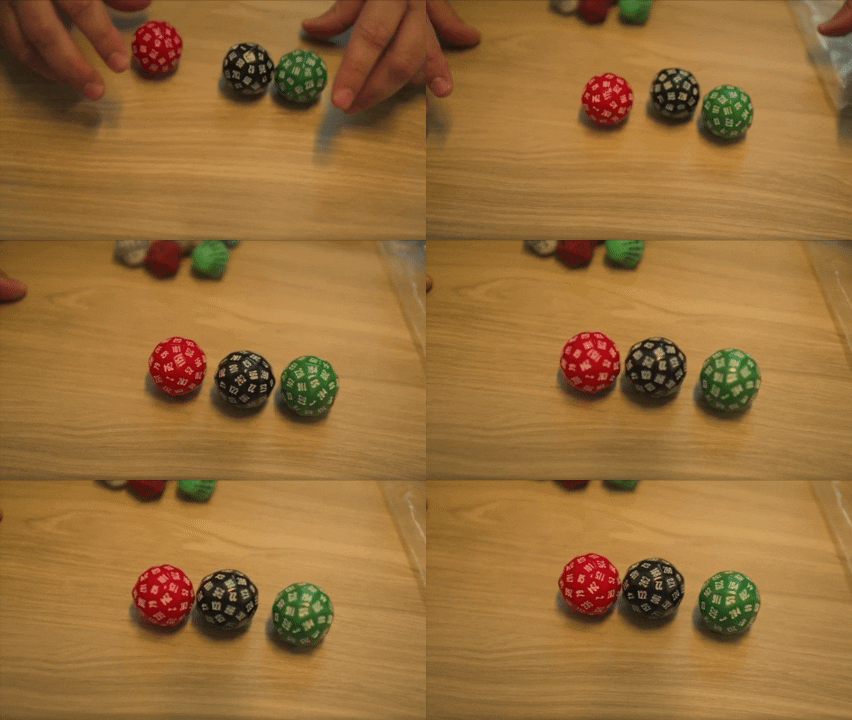
Then, six years later, ANU cryptologist Michael Purcell presented Harshbarger with the holy grail: a set of five Go First dice that were fully permutation fair. With 120 sides each, they were fiddly to the point of uselessness – but their discovery was hugely important, and not only because it showed that the problem could, in fact, be solved.
“It not only lower[ed] the LCM of a 5-player homogenous set,” Harshbarger wrote – meaning, in effect, that the “most difficult” an answer could be had been reduced – but it had also been found in a completely novel way. “Michael's method of generation [was] significantly different than the induction method I had been using up to [that] point,” he explained.
So, the problem was for sure solvable. And then, in 2023, Harshbarger, along with Ford, Grime, and Pollock, published a paper with five sets of five 60-sided Go First dice that fit even the strongest condition of fairness.
“We kind of feel like, ‘OK, mission accomplished. This is great,’” Harshbarger said.
Finishing touches
To close a problem that’s stumped the world – or, at least, your corner of it – for more than a decade must be satisfying. For your place of work to install a giant statue commemorating it – well, that’s just the icing on the cake.
Throughout the study of these Go First dice, Harshbarger had been creating prototypes of the solutions he found – at least, those which were possible to recreate. “Of all the 5-player sets I've been able to create mathematically, a factor of 9 always seems to crop up in at least one of the necessary face counts,” he lamented in his blog. “This is serious problem, because, other than a few clunky triangular-dihedral or barrel designs, a fair geometric polyhedron cannot be formed with 9n sides.”
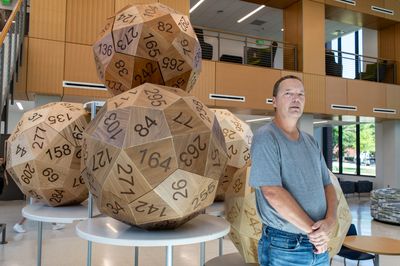
But with an eminently makeable set of 60-sided dice, Harshbarger set about crafting a sculpture of all five, each around 3.5 feet (107 cm) in diameter – and Auburn University provided him with the perfect place to put them. A brand-new, $224-million building for the university’s STEM and agricultural sciences departments, designed specifically with space for math-related visual installations.
As for the Go First dice problem – well, it’s still open, technically. A solution may have been found for five players, but no more than that – six is still waiting to be solved. Even for the group sizes already solved, there are still unique ways to approach the problem: what if we don’t require all the dice to be the same shape, for example? What’s the smallest number of sides you’d need overall? (The record for five dice is currently 164 sides. For four, the lowest possible is 30.)
Of course, there’s one elephant in the room.
“Five-player permutation-fairness can actually be achieved on a single die, if that die is 120-sided,” admitted Harshbarger. “The number of ways five players can be ordered is 5! (5-factorial), which equals exactly 120. So, one could label the 120 sides of such a die with all possible orderings of the letters A, B, C, D, and E.”
It would work, and it has the benefit of not needing 13 years’ worth of research to discover it. But it’s far from a perfect solution, at least from a gaming perspective.
“The d120 is a big die,” Harshbarger pointed out – noting that he had a prototype that was “the size of a baseball and weighs about 3/4 of a pound [340g].” It would mean nobody got to choose their own die, and it would roll for a very long time – “this is a problem with all dice above 30 faces or so,” Harshbarger wrote.
Ultimately, “even though this d120 scheme would work,” he concluded, “it's just not as much fun.”