Space and Physics
 PUBLISHED


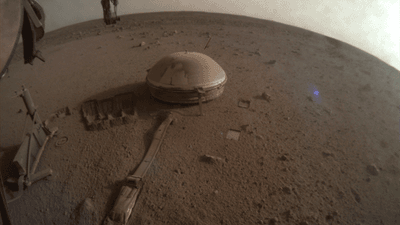


Here's one of the cool things you learn when you land a seismometer on another planet: Mars's days are getting shorter. Or to put it another way, the planet is spinning faster.
That was discovered back in 2023. A team using data from the Rotation and Interior Structure Experiment (RISE) on NASA's InSight Lander on Mars found that the Red Planet’s rotation is accelerating by around 4 milliarcseconds per year², shortening the Martian year by a fraction of a millisecond.
That isn't a whole lot, but it has been a bit of a mystery as to why.
"They have a few ideas, including ice accumulating on the polar caps or post-glacial rebound, where landmasses rise after being buried by ice," a NASA statement explains. "The shift in a planet’s mass can cause it to accelerate a bit like an ice skater spinning with their arms stretched out, then pulling their arms in."
Now, a new study has proposed that the increase in rotation speed could be due to a "substantial gravity anomaly" around the Tharsis volcanic province on Mars. The researchers were initially interested in reevaluating how the province, home to the largest volcanoes in the Solar System, came to be. New data from InSight placed better constraints on the properties of the lithosphere (or the rigid, rocky shell of a rocky planet) and its thermal and mechanical structure, allowing for the researchers to construct better models of the region.
There are other clues to work with. From the 1970s, tracking data from Mariner 9, Viking 1, and Viking 2 have been used to gain a sense of the gravity strength on Mars, and that has become far more precise since the 1990s with the launch of the Mars Global Surveyor, Mars Odyssey, and the Mars Reconnaissance Orbiter. Using data from these spacecraft, scientists have mapped Mar's gravity pretty well, and found a few anomalies.
"The Martian gravity anomalies show a strong correlation with the Tharsis Region," the team explains in their paper. "The center of a positive free-air anomaly (300–500 mGal) after correcting for most of the rotational flattening is centered in between Ascraeus Mons and Pavonis Mons. A pronounced negative gravity ring (−200 mGal) surrounds the bulge of the Tharsis Rise."
Gravitational anomalies are the somewhat dramatic name we give to the phenomenon when the measured gravity strength differs from what we expect, given what we know of the mass distribution of the ground below. A number of ideas have been suggested for the gravity anomalies at Tharsis, including that the region was formed following a large impact event in the planet's past, or that the whole region sits on top of a supportive impact site formed even further back in Mars's history.
"Another explanation could be that an active mantle plume underneath the Tharsis Rise maintains the extreme surface elevation and is responsible for the observed global gravity signal," the team writes, adding that the idea is not new, but has recently been given further credibility with evidence of recent volcanic activity at Tharsis, and possible evidence of mantle plumes beneath Elysium Mons in Mars's Eastern hemisphere.
Modeling the inner workings of the planet, to see what could plausibly produce such features, the team found that best fit was a "substantial negative mass anomaly" around 1,200 kilometers (745 miles) beneath the surface. Further evidence is needed, but according to this work, Mars might not be as geologically dead as we thought.
"Hot mantle plumes could be the explanation for volcanic activity and local thinning of the lithosphere. To explain late-to present-day melt Mars needs a substantial hot mantle and high activation energy of the mantle rock," the team explains. "If confirmed, this would result in partial melting pockets in the mantle penetrating through the crust, which was seen to be difficult to reconcile with large elastic thickness estimates that suggest Mars is a cooled and sub-chondritic planet. Our results show that it is plausible that a dynamic signature is needed to explain the topographic and gravity signature of the Tharsis Region."
As the mantle plume – lighter than surrounding mantle – makes its way towards the surface, it could stimulate volcanic activity, creating melt pockets which can then turn into volcanoes when they reach the crust.
As well as this, the team suggests that a mantle plume beneath the region is a reasonable fit with Mars's increased rotation speed, with a more active planet resulting in more variations in the rate of spin.
"Recent observation of the Mars rotation rate could explain our estimates of a negative mass anomaly rising upward. The change of internal density would affect the moment of inertia of the planet and that would affect the rotation of the planet," the team writes in their paper. "We show [...] that this rotation rate acceleration in first order could be explained by our estimated mass anomaly."
While interesting, further evidence-gathering and analysis is needed. For example, we don't have enough data on the viscosity of Mars's mantle, leading to uncertainties in the modeling. The team suggests further gravity-modeling missions to the planet in the future, to gain further insights into Mars's subsurface.
The study is published in JGR Planets.