Nature
 PUBLISHED
 1
1


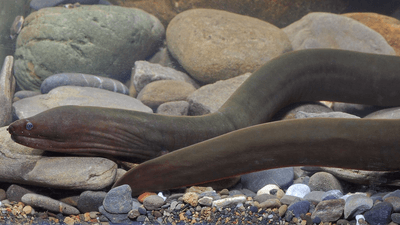


A new-to-science moray eel has been discovered lurking in the dim river mouths of the Central Indo-Pacific, inspiring a species name that’s a hat-tip to the ruler of the underworld, Hades. With a name that means “the unseen one,” Hades seems fitting for an eel whose dark coloration means it blends seamlessly into mud.
Its full species name is Uropterygius hades, as inspired by Dr Wen-Chien Huang, first author of the study describing the new species – the scientist was influenced by Ralph Fiennes' portrayal of Hades in the movie Clash of the Titans. An impressive name, it seems, for an equally impressive creature, as this strange moray eel has a few tricks up its tail.
Of the 230 moray species known to science, we’ve only been able to confirm that one spends the majority of its life in freshwater. Of the marine species, there’s only a handful that can tolerate the lower salinity you find near estuarine habitats like river mouths, so to find an estuarine specialist moray eel is really quite rare.
It’s perhaps unsurprising, then, that the discovery of U. hades was something of an accident. Three researchers from National Sun Yat-sen University were investigating a cave along the Philippines' Puerto Princesa Subterranean River, in search of the bean-eyed snake moray, Uropterygius cyamommatus. Its beany eyes make it well adapted to cave life, but when the researchers went looking for it, they found something else entirely.

What they had stumbled upon was some kind of slender moray eel with a uniformly dark coloration. Not only was it rare as an estuarine specialist, but when captured and placed in a tank it did something known as tail-first burrowing, which is also very unusual for a moray eel.
The morays also had small eyes and a reduced number of sensory pores on their heads, traits that could be handy for river mouth life where the muddy conditions can clog you up somewhat. In which case, the combination of its tail-first digging and sensory adaptations may indicate that this new-to-science species is an excellent burrower.
“Uropterygius hades sp. nov. represents a rare species of moray eel that inhabits turbid estuarine environments, preferring soft, muddy substrates, and burrowing and hiding among rocks or in fallen mangrove leaves,” concluded the study authors.
“Furthermore, we observed that U. hades sp. nov. is highly sensitive to light and consistently attempts to hide when exposed to it. This suggests that it may typically inhabit turbid waters such as estuaries, resulting in its lack of acclimation to light exposure. The small eye proportion of U. hades sp. nov. may also indicate its adaptation to low-light conditions, wherein they primarily use their chemoreception rather than vision to detect prey or avoid predators.”
Who wants 20/20 vision when you’ve been specifically tasked with ruling over the deceased, anyway?
The study is published in ZooKeys.