Space and Physics
 PUBLISHED


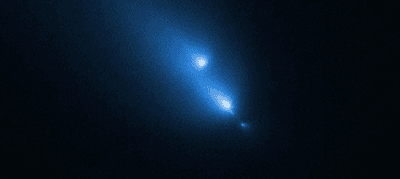


Toward the end of last year, a comet shattered into pieces as it hurtled through the Solar System. By the "slimmest of chances", the violent breakup was captured by the Hubble Space Telescope, which just happened to be staring at the comet during its fragmentation because its original target wasn't viewable at the time.
C/2025 K1 (ATLAS), known as K1 for short, was first spotted in May 2025 using the Asteroid Terrestrial-impact Last Alert System, the same astronomical survey that got the first glimpse of 3I/ATLAS. It was slightly larger than an average comet, around 8 kilometers (5 miles) in diameter, with a distinctive chemical composition that's weirdly low in carbon.
On October 8, 2025, K1 reached perihelion, the point in its orbit where it passed closest to the Sun, skimming past our star at a distance of roughly 49 million kilometers (30 million miles). Comets of this kind often don't survive such a close solar encounter, either evaporating or being torn apart by the intense heat and gravitational forces. K1 initially appeared to have made it through unscathed, but the grueling journey ultimately took its toll.
In early November 2025, the comet was seen crumbling into pieces. A handful of telescopes captured the spectacle, but as it turned out, another iconic star-gazer had also been watching: Enter Hubble.
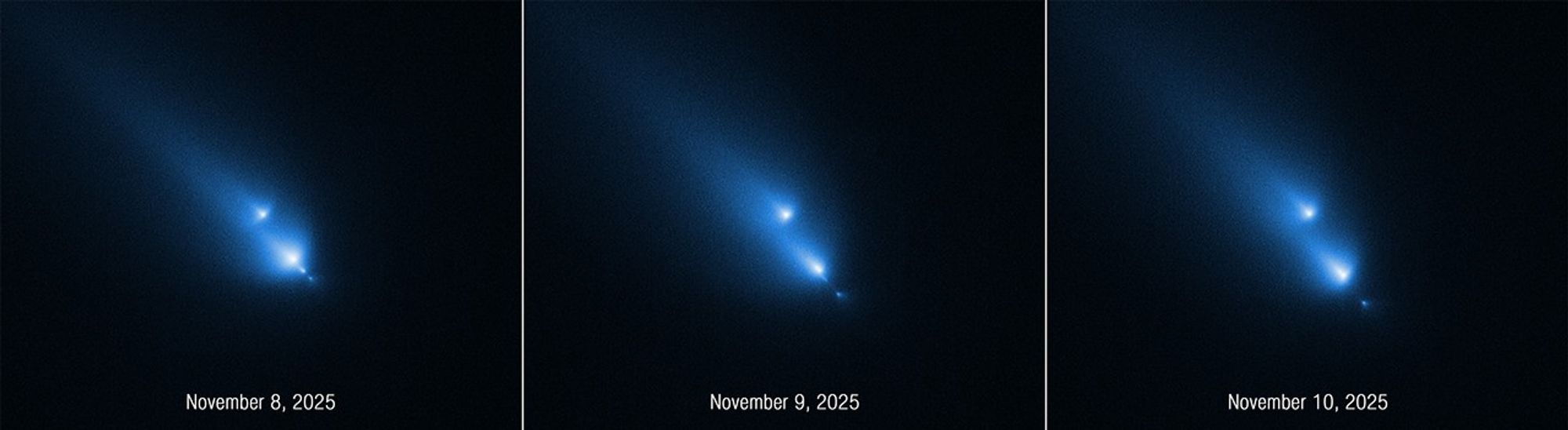
This was a real stroke of luck. The astronomers were actually attempting to image another comet breaking up, a tricky feat that often ends in failure as space rocks can be unpredictable and time on telescopes like Hubble is booked in advance. When their attempt to capture the original target fell flat, they turned their attention to comet K1, which unexpectedly began to disintegrate.
“Sometimes the best science happens by accident,” John Noonan, co-investigator and research professor in the Department of Physics at Auburn University, said in a statement. “This comet got observed because our original comet was not viewable due to some new technical constraints after we won our proposal. We had to find a new target — and right when we observed it, it happened to break apart, which is the slimmest of slim chances."
“The irony is now we're just studying a regular comet and it crumbles in front of our eyes,” said principal investigator Dennis Bodewits, also a professor in Auburn University’s Department of Physics.
Hubble’s images show K1 fracture into at least four pieces, each with a distinct coma, the fuzzy cloud of gas and dust that surrounds a comet’s icy nucleus. One of these smaller fragments then also broke into pieces.
This chance observation could prove to be a boon for astronomers studying comets. By precisely tracking the positions and trajectories of the scattered debris, they could wind the clock back and reconstruct the fragmentation timeline almost piece by piece.
Strangely, this revealed a curious gap between the moment K1 broke apart and the moment ground-based observers noticed it flaring in brightness. Freshly exposed ice, normally volatile and reflective, should have lit up almost immediately. So why the delay?
The team has floated a couple of theories. A comet's glow is largely sunlight bouncing off fine dust particles, but a freshly cracked comet also reveals raw, pristine ice beneath. One idea is that a thin crust of dry dust must first coat that ice and then be blasted away before the outburst can begin. Another is that heat slowly penetrates below the surface, building pressure until it finally erupts, launching an expanding cloud of dust into space.
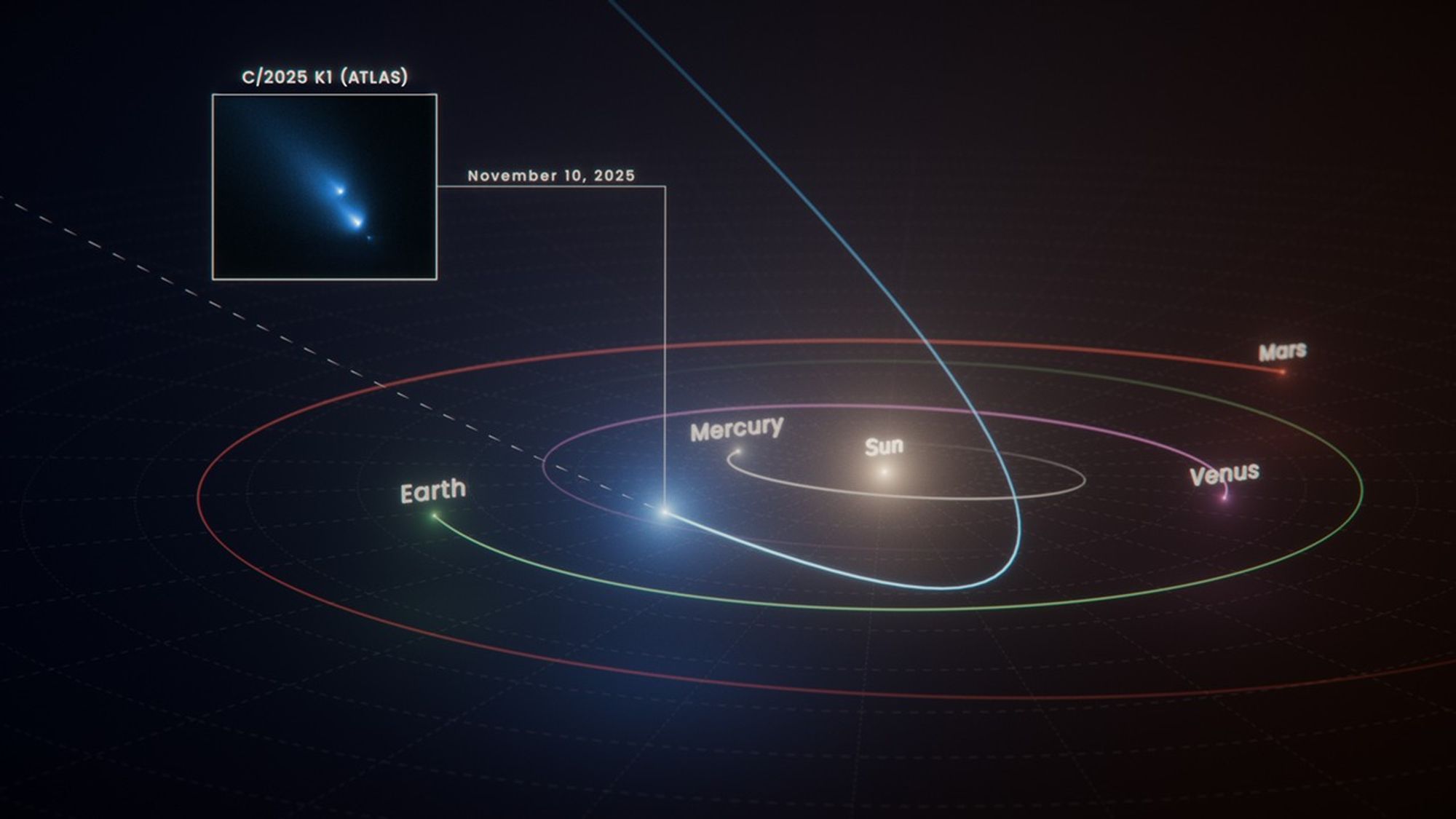
“Never before has Hubble caught a fragmenting comet this close to when it actually fell apart. Most of the time, it's a few weeks to a month later. And in this case, we were able to see it just days after,” said Noonan. “This is telling us something very important about the physics of what's happening at the comet’s surface. We may be seeing the timescale it takes to form a substantial dust layer that can then be ejected by the gas.”
Unfortunately, K1 is no more. The comet is now a flying cloud of fragments around 400 million kilometers (250 million miles) from Earth. Its trajectory suggests it’s heading out of the Solar System, unlikely to ever return.
The new study is published in the journal Icarus.