Space and Physics
 PUBLISHED
 1
1


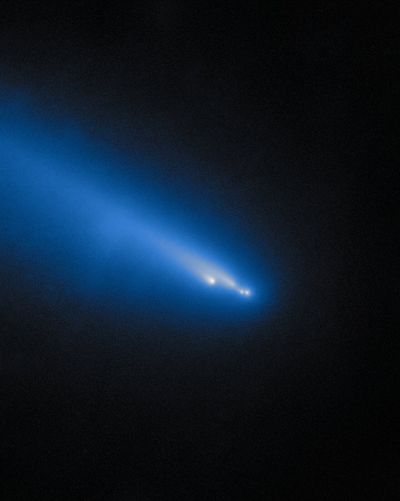


Telescopes have captured the dramatic process of a comet crumbling into multiple pieces as it journeyed through our Solar System. Freshly released images from the Gemini North telescope in Hawaii show Comet C/2025 K1 (ATLAS) in the midst of breaking apart between November 11 and December 6, 2025, splintering into a scattering of fragments.
C/2025 K1 (ATLAS) was first identified in May 2025 using the Asteroid Terrestrial-impact Last Alert System, the same astronomical survey that got the first glimpse of 3I/ATLAS.
Unlike that high-profile visitor from beyond the Solar System, K1 (ATLAS) is a relatively local body that originated in the Oort cloud, a giant spherical shell on the very outer edges of the Solar System. This distant region contains billions of icy bodies, some of which are occasionally “kicked” inward to become comets.
On October 8, 2025, the comet made a perilous "perihelion" (closest approach to the Sun), zipping past our star at a distance of just 49 million kilometers (30 million miles). Strangely, this cosmic traveler had a golden glow in its coma and tail, indicating that it was surprisingly carbon-poor.
While most comets of this type evaporate or disintegrate during their solar flyby, K1 (ATLAS) initially seemed like a survivor. It defied the odds to survive perihelion passage and even brightened to a magnitude 9, vivid enough to be seen from Earth with a decent pair of binoculars or a small telescope.
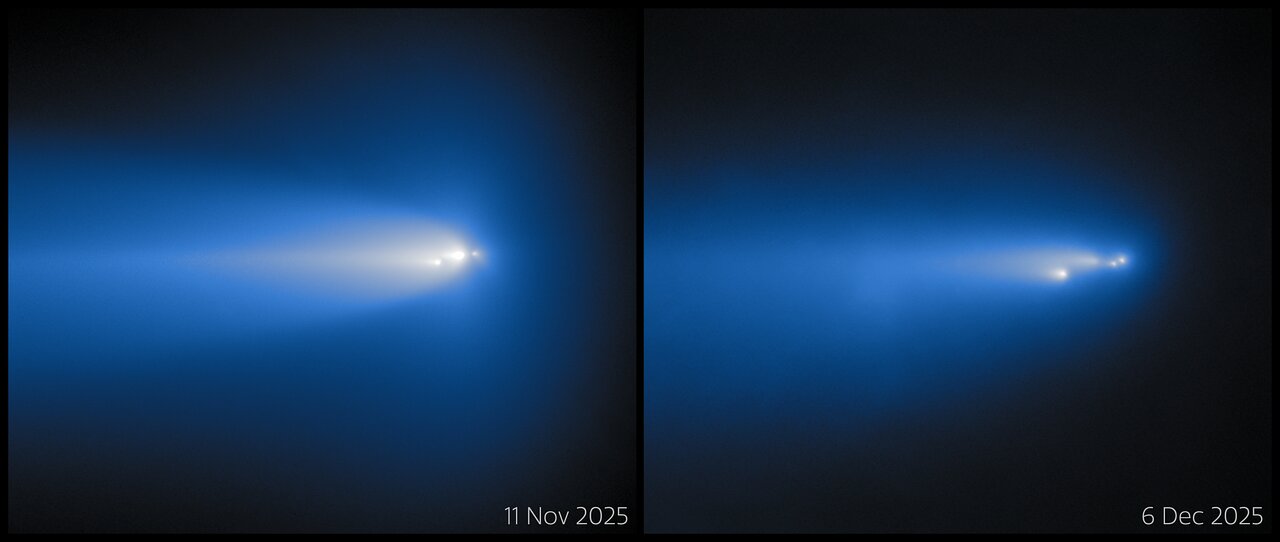
However, its risky journey eventually took its toll. On the night of November 11, the comet was seen crumbling into pieces. This newly released side-by-side shot shows a comparison of the comet between November 11 and December 6, 2025, revealing its continued disintegration in striking detail. The images (above) show the nucleus splitting into at least three or four major fragments, trailing a shimmering wake of dust and debris.
The comet is likely to be in its final death throes as it recedes from the Sun. As of February 2, 2026, the estimated magnitude of K1 (ATLAS) is approximately 27.17, indicating that it has faded to extreme faintness. This is far beyond the reach of all but the most powerful telescopes, suggesting it is little more than a diffuse cloud of debris, rather than a single, intact comet.
It's been nice knowing you, Comet C/2025 K1 (ATLAS); a short but sweet encounter.