


 Space and Physics
 PUBLISHED



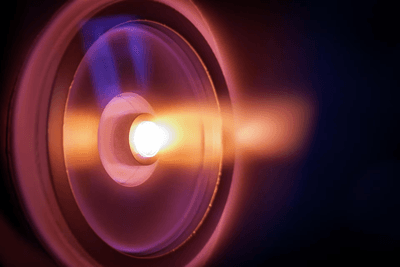


The extreme conditions spacecraft have to survive to safely reenter Earth's atmosphere have been difficult to reproduce in the lab. Now, a unique facility has been developed with just this scenario in mind.
When a spacecraft comes back from orbit, it will experience something incredible and very dangerous. It comes in at enormous speed, and the air friction slowing it down releases so much energy that the air molecules are ripped apart, forming a plasma, a fluid of electrically charged particles. This plasma can be several times hotter than the surface of the Sun, and – importantly – you want to your spacecraft to survive the encounter.
Just like a wind-tunnel is used to test how aerodynamic vehicles can be, researchers at the University of Colorado at Boulder have now developed an inductively coupled plasma tunnel. This facility still generates extreme flow, moving between hundreds and thousands of kilometers per hour, but the flow is not just air like in a wind tunnel. This one-of-a-kind testing ground uses plasma almost as hot as the surface of the Sun.
"There's not a chamber exactly like this anywhere in the world," Hisham Ali, assistant professor in the Ann and H.J. Smead Department of Aerospace Engineering Sciences, said in a statement.
Ali and his students are testing how new materials and new tech deal with this extreme environment. Currently, spacecraft use angles of reentry and specific maneuvers and specific material to slow down safely through the atmosphere. It could be possible to use magnets during these phases to direct the plasma and maneuver vehicles, but this is not yet possible with today’s technology. This is something that the plasma tunnel can test.
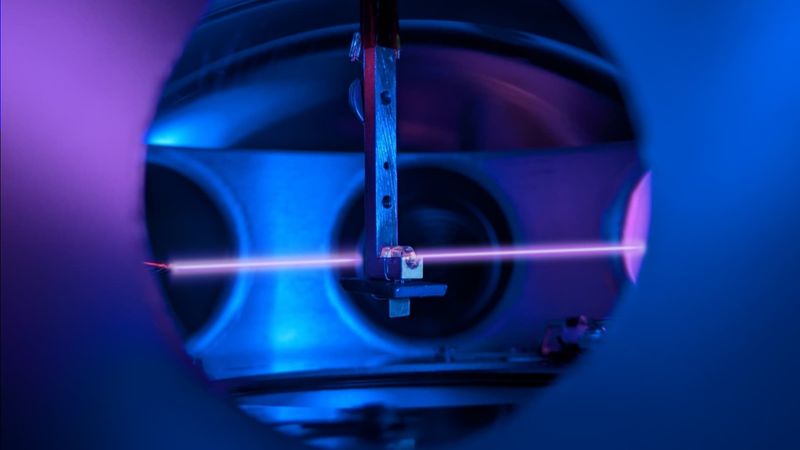
The plasma flows into a large chamber sealed in stainless steel. It comes through a tube made of quartz glass, roughly the size of a wine bottle. The speed is simulated using a powerful vacuum pump that can suck 20,000 cubic meters (over 706, 000 cubic feet) of air per hour. This is one of the most powerful machines of its kind at any university in the United States.
The heat is produced by first having argon in the chamber, which is heated thanks to alternating radio waves. The radio waves generate powerful electric fields that ignite the argon. Once the argon is lit, the team injects air to create exactly what a spacecraft would experience coming back to Earth. But it can also simulate other planets.
"Once our plasma is lit, we can inject carbon dioxide and create a plasma made of flowing carbon dioxide, similar to what a spacecraft might experience at Mars," Ali added.
In a matter of weeks, now that the launch has been postponed, the Artemis II astronauts will go around the Moon and then come back to Earth. The return will lead them to break the speed record for any human traveling in space, coming in at 40,000 kilometers (about 25,000 miles) per hour.
The heat shield on the Orion spacecraft suffered some unexpected cracks during Artemis I, which was uncrewed. While the spacecraft landed unharmed, the space agency does not want to take any risks with the astronauts. NASA had to take time to improve it, which was one of the factors leading to the delay in Artemis II.

 1
1