Space and Physics
 PUBLISHED



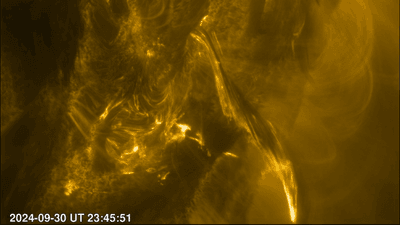


Solar flares have an enormous impact on the wider Solar System. These sudden releases of energy can cause geomagnetic storms on Earth and radio blackouts too, like the one that's happened in the last few days. But how flares start has remained poorly understood, at least until now. The European Space Agency’s Solar Orbiter has provided the most complete picture of the triggering of a solar flare to date.
Thanks to observations from four of the mission’s instruments, researchers were able to watch the buildup to the event that led to the release of the flare. They studied the 40 minutes before the flare and saw that the behavior of the magnetic field lines was akin to what happens before an avalanche. Weak disturbances suddenly became more violent, raining blobs of plasma onto the Sun.
It’s the first time that this level of detail, both in space and time, has been seen in the solar corona.
“These minutes before the flare are extremely important and Solar Orbiter gave us a window right into the foot of the flare where this avalanche process began,” lead author Pradeep Chitta of the Max Planck Institute for Solar System Research, said in a statement. “We were surprised by how the large flare is driven by a series of smaller reconnection events that spread rapidly in space and time.”
The flare in question was released by the Sun on September 30, 2024. It was an M7.7 class flare – not as powerful as the X-class flares that produce the most serious effects on Earth, but still, it had a kick. The observations showed that the brightness of the material was slowly rising before the observations took place, both in ultraviolet and X-rays. The plasma was getting hotter and hotter.
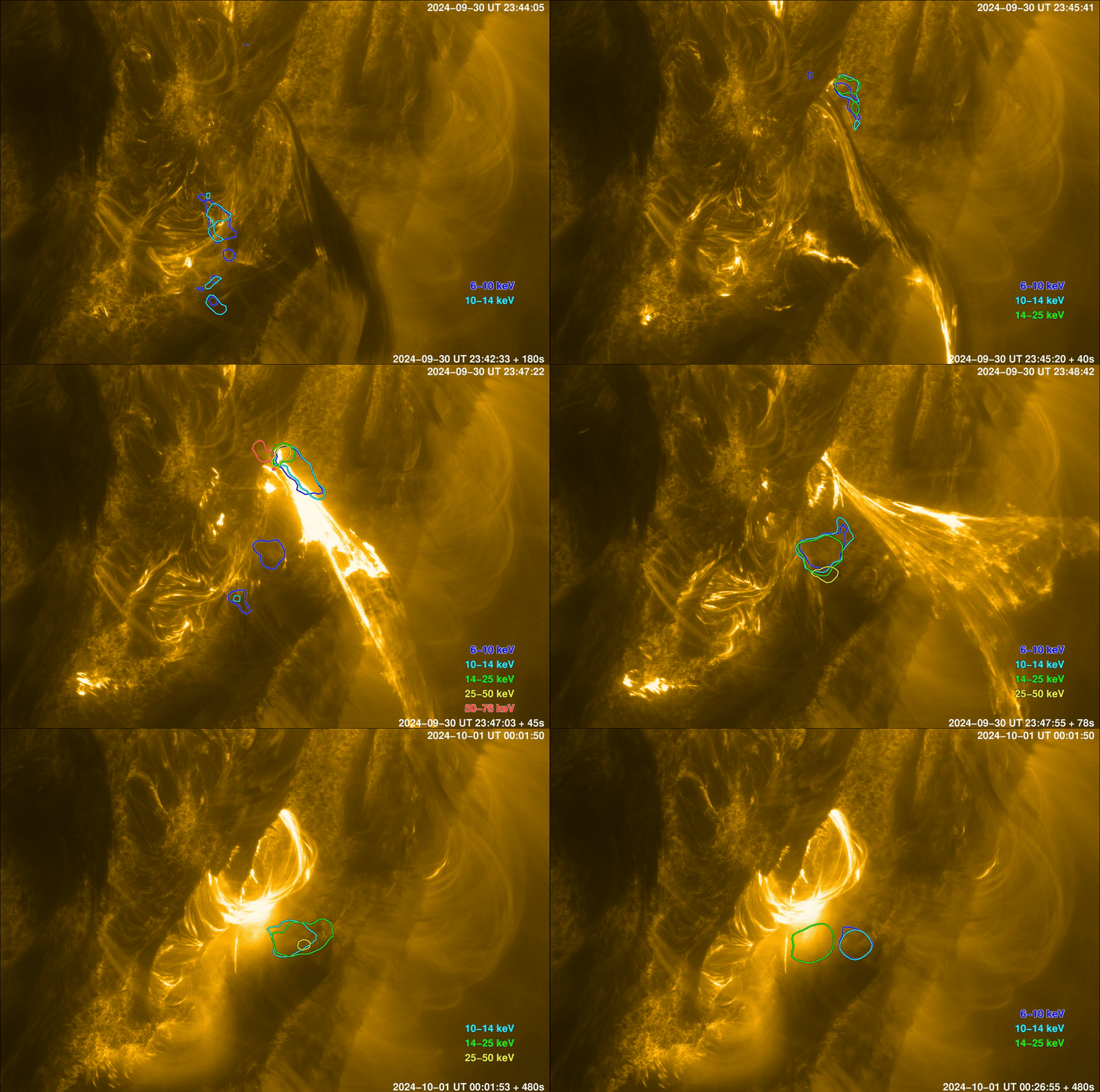
During the flare, the magnetic field lines experienced reconnection, which means they broke apart and reconfigured into a new shape, heating and accelerating the particles to 40 to 50 percent of the speed of light. The process dumped a lot of energy into the surrounding plasma, helped by the plasma blobs raining down, which began before the flare and continued for some time afterwards.
“We didn’t expect that the avalanche process could lead to such high energy particles,” added Chitta. “We still have a lot to explore in this process, but that would need even higher resolution X-ray imagery from future missions to really disentangle.”
“This is one of the most exciting results from Solar Orbiter so far,” said Miho Janvier, ESA’s Solar Orbiter co-Project Scientist. “Solar Orbiter’s observations unveil the central engine of a flare and emphasise the crucial role of an avalanche-like magnetic energy release mechanism at work. An interesting prospect is whether this mechanism happens in all flares, and on other flaring stars.”
The study is published in the journal Astronomy & Astrophysics.