Space and Physics
 PUBLISHED


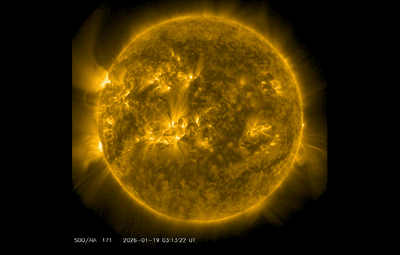


Yesterday, sunspot 4341 unleashed an X-1.95 strength flare, accompanied by a large coronal mass ejection and so-called “flare ribbons”. Although far from record-breaking in power, the flare was unusually long-lasting and occurred over a vast area of the Sun. With the radiation unleashed being directed towards the Earth, the flare may have sent a shiver through the astronauts on the forthcoming Artemis II mission, although mission engineers are not showing alarm.
One of the major projects of the Artemis II mission is to test the danger posed to astronauts from radiation. However, the intent is for that to be done gently, rather than frying the astronauts at first attempt. Even the most powerful solar storm is unlikely to be fatal, but a repeat of yesterday’s explosion would still bathe the Orion spacecraft in more radiation than anyone thinks is ideal.
Earth provides several layers of protection from space radiation. Even traveling in an aircraft increases one’s exposure to cosmic rays by virtue of being above most of the atmosphere. On the International Space Station, the radiation exposure is more extensive and more damaging. Nevertheless, the Earth’s magnetic field and belts of trapped charged particles are still protecting the astronauts from a lot of radiation that would be experienced further out.
.gif "The Sun lights up over a vast area in this image taken by the solar dynamics observatory")
Artemis II will carry with it the AVATAR experiment that will explore the effects of this radiation on tissue made from the Astronauts’ own bone marrow. However, the radiation it will encounter is far from consistent. It’s a combination of cosmic rays coming from diverse sources such as supernovae and star clusters, and what is emitted by the Sun. The solar component spikes dramatically after eruptions as the Sun spits out highly charged particles, at least when the flare is directed towards the Earth-Moon system.
The Artemis mission has a contingency for major solar storms, since the Orion capsule’s outer shell might not be sufficient. NASA’s Jason Hutt answered a question on BlueSky about the protection available to the astronauts saying, “We have a radiation shelter as close to the center of the vehicle as we can get… we’re putting as much mass between the source of radiation and the crew as possible. The middle 2 stowage bays in the floor of the cabin are big enough for 2 crew members each.” The items that are normally kept in the stowage bays would be used to line the cabin’s walls, acting as an additional shield.
To provide enough air to the bays, Hutt added, astronauts would use tubes to their suits.
Solar flares come in a range of strengths, with X-class flares the largest. Nevertheless, an X 1.95 flare is far from the maximum possible. A flare in 2003 was estimated to be X28-45, 14-23 times as powerful as sunspot 4341’s effort. However, flares are categorized by the flux at their peak; an extended flare such as this one can release more radiation than one that peaks higher but more sharply.
.gif "At these wavelengths the flare doesn't look as bright at peak, but it's easier to see the way it propagated")
Solar astronomer Dr Ryan French of the Laboratory of Atmospheric and Space Physics said on Bluesky, “The physical volume of the flare is the biggest I’ve seen in a long time.” French noted the brightening visible to the right of the most intense region is part of it, adding, “The fainter brightenings are called ‘flare ribbons’, and mark the intersection with the flare’s magnetic fields (in the Sun’s atmosphere), with plasma closer to the Sun’s surface.”
The event was reportedly powerful enough to create a solar proton storm and interfere with shortwave radio reception across large parts of the planet. The effect lasted for hours within the Arctic Circle. As is often the case for large flares, the event also launched a major coronal mass ejection, which is expected to produce a G4-class geomagnetic storm on Tuesday when it reaches Earth. That could produce spectacular auroras, particularly with the Moon so new.
Even though Artemis II’s rocket has reached the launch pad, take-off will not occur before February 6 at the earliest, by which time any activity from this flare will be long past. However, the event is a reminder that solar cycle 25 is not going gently into that good night, and plenty of activity can be expected over the next few months.