Nature
 PUBLISHED
 1
1




Everyone's heard the pop culture myth that cockroaches are virtually indestructible and will be the only animals to survive the apocalypse. If those end times involve Biblical floods or sea level rise, these grimy bugs may now have an even better shot at being the last one standing.
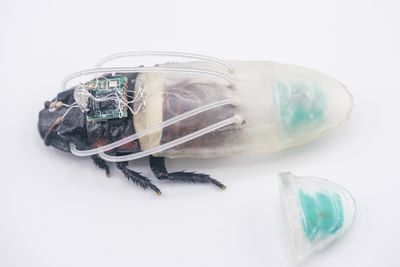
In a new study, cyborg cockroaches equipped with an integrated diving suit that lets them move underwater have been developed by scientists at Nanyang Technological University in Singapore and Waseda University in Tokyo.
How does the cyborg insect work?
The cyborg system takes advantage of the way that the cockroaches get hold of oxygen for respiration. Instead of lungs and windpipes, insects take in oxygen through a network of tiny tubes running along their bodies. Rather than relying on blood, these tubes feed oxygen directly to the body's cells.
To accommodate this structure, the suit features four silicone oxygen-supply tubes that feed directly into their natural pipework. Those artificial tubes are connected to an oxygen-generation tank on the bug's back containing diluted hydrogen peroxide. Once manganese dioxide is added as a catalyst, it slowly breaks down the peroxide to release oxygen.
Along with its underwater abilities, the cyborg suit is fitted with electronic controllers that guide the bug's movement remotely. Since the insect still uses its own muscles to move, there’s no need for batteries or mini power cables.
All together, the system allows the cockroach to move around and stay underwater for up to three hours. They can even emerge from the water and seamlessly walk on land, just like a truly amphibious creature.
“The key engineering challenge was to build a system that was small, light, and flexible enough for the insect to wear, while still producing enough oxygen for long-duration underwater movement, Professor Shinjiro Umezu, School of Creative Science and Engineering, Waseda University, said in a statement.
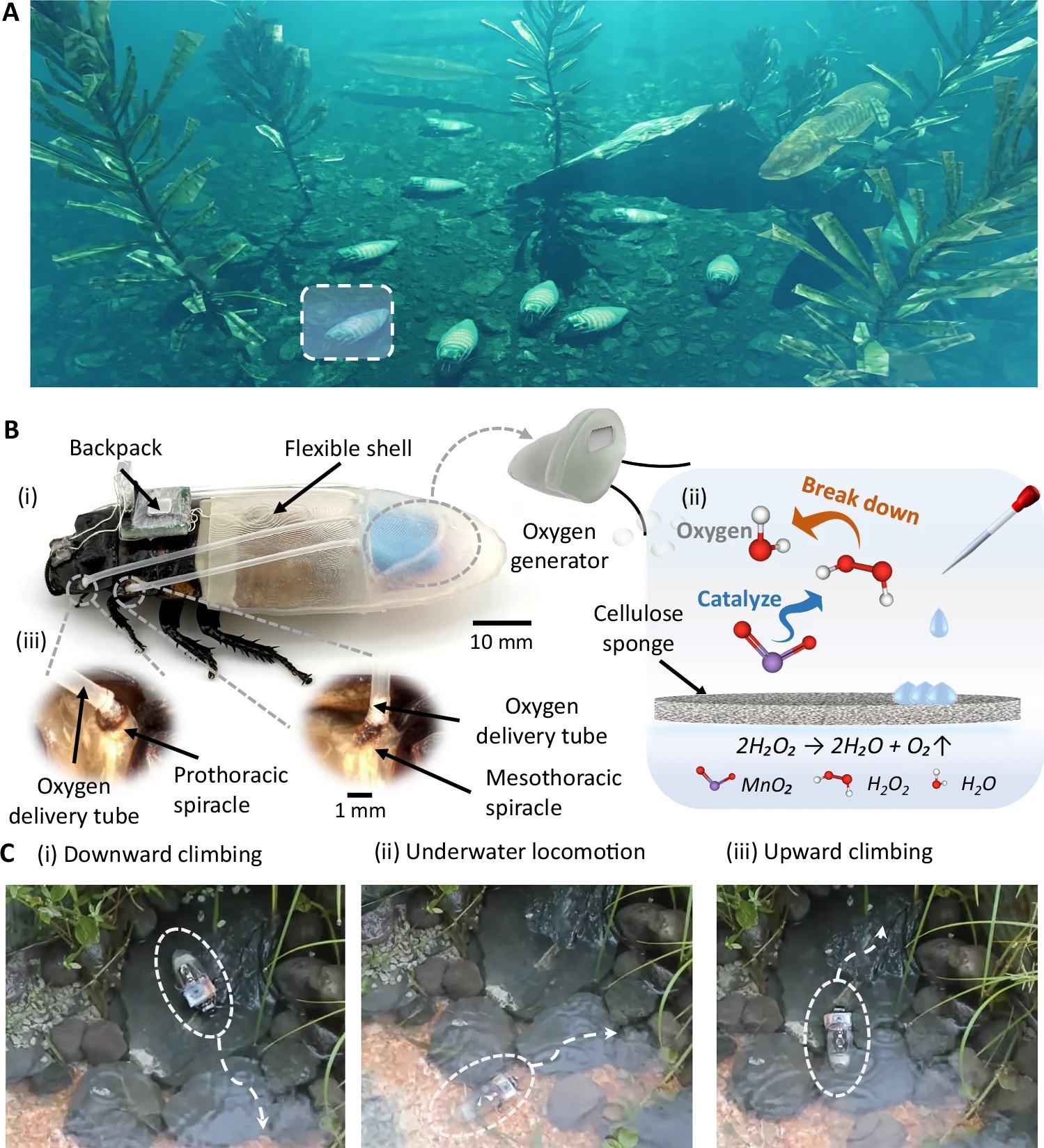
“Our approach combines a soft waterproof shell with a simple yet reliable chemical oxygen generator. This allows the insect to retain its natural mobility while being protected from an environment that it cannot normally survive in.”
Why, oh why, did they make cyborg cockroaches?
This all sounds great, you might be thinking, but what is the point?
The researchers believe that cyborg insects – half-organic, half-artificial – are actually better suited than conventional robots for jobs like exploring difficult and dangerous environments. By combining the best of biology with a bit of tech, they're able to move through the real world the way that natural selection has refined for millions of years, just with some extra machinery bolted on.
This isn’t just a pipe dream, either. The lab’s cyborg insects were deployed in the real search-and-rescue efforts after Myanmar’s 7.7-magnitude earthquake in March 2025. A team of Madagascar hissing cockroaches was fitted with infrared cameras and sensors, then navigated around the ruins using electrodes and remote sensors. This information was then processed by a machine-learning algorithm, which could work out if there were signs of life.
Now with this scuba diving technology, there are even more risky environments that the cockroaches could potentially explore, from cracks in underwater caverns to water-filled sewer pipes.
“Our new insect diving suit works like the oxygen tank used by human divers. It generates oxygen and delivers it directly to the insect’s breathing holes, allowing the cyborg cockroach to survive and move in underwater or low-oxygen environments,” added Professor Hirotaka Sato, leader of the study from NTU Singapore.
“This is important because real disaster sites can be challenging after heavy rain or flooding, blocking access routes in the rubble, drains, and narrow gaps. By expanding the operating parameters of our cyborg insects to include underwater travel, we believe that they can enhance search and rescue efforts,” said Professor Sato.
The study is published in the journal Nature Communications.