Technology
 PUBLISHED
 11
11


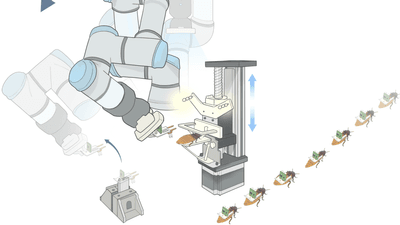


How do you create an army of cockroach cyborgs? Why, you enrol the robots, of course. That’s the direction a new preprint study has taken in equipping cockroaches with little backpacks in under 68 seconds using an automatic assembly method, something they’ve termed the “Cyborg Insect Factory”.
It sounds like nightmare fuel, but it’s actually a smart approach to search and rescue that’s being explored in a few ways. We’ve already looked into robotic snakes and living rats, so why not try a cyborg cockroach?
There have been a few models of cyborg roaches already, including ones with their antennae attached to their backpacks, while others had jazzy solar-powered packs. This latest project stands out in focusing on a means of scalable creation, since given their size, you’re probably not going to be able to achieve a lot with one wee cockroach in a big search and rescue operation.
What if, say, you could create an automatic system capable of equipping the cockroach with its little electric backpack in a little over a minute? Would it then be possible to create a scalable operation of mini cyborg-roach soldiers?

Well, according to the researchers it takes just 68 seconds for the whole assembly process at their Cyborg Insect Factory, creating steerable, speed-controlled roaches that match the performance of manually assembled systems. Such speedy assembly was made possible through a deep learning-based vision system that could accurately identify the implantation site on the roaches, which were fixed in place with a dedicated structure.
The roaches themselves were Madagascan hissing cockroaches, Gromphadorhina portentosa, meaning your rescue might be a noisy one. They create the sound by forcing air through respiratory spiracles, creating a loud noise that can signal aggression, courtship, or disturbance.
They’re also long-lived arthropods, with a typical lifespan between two and five years meaning you could make use of your giant cyborg roach army for quite a while. As experts in navigating complex terrain, they’d be able to stay on their feet far better than any biomimetic robots humans have dreamt up to date, so who knows – perhaps our future saviors could be one of the most wrongfully maligned creatures on the planet?
“The advancement of insect-computer hybrid robots holds significant promise for navigating complex terrains and enhancing robotics applications,” write the authors. “The proposed automatic assembly strategy reduced preparation time for the insect-computer hybrid robots while maintaining their precise control, laying a foundation for scalable production and deployment in real-world applications.”
The preprint, which is yet to undergo peer review, is hosted on arXiv.
[H/T: Interesting Engineering]