Nature
 PUBLISHED
 5
5


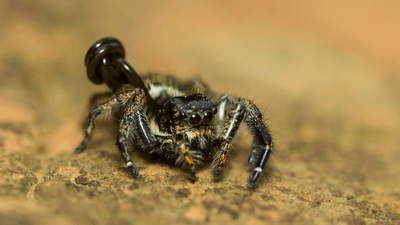


Eight legs really seem to do something to people. Even bring up the subject of spiders and you’ll have some people shuddering, but this writer has stumbled upon something that quite honestly makes spiders look cute and cuddly compared to what’s lurking within them. Real-life Alien is already on Earth, and its name is Mermithidae.
Mermithidae refers to a family of nematode worms known to parasitize various arthropods (that’s your crunchy invertebrates, like insects, arachnids, and crustaceans). Most of these nematodes target insects, but there are a few rarer specialists that come for the other arthropods.
The worms can enter their host either by directly penetrating their tissues, or they may have penetrated another critter that the spider then hunts and eats, not realizing it's getting a bonus snack that will go on to cause a lot of problems. The worms can grow to enormous sizes as they develop within their host, coiling up as they feed and grow, all the while the host’s vital organs remarkably remaining intact.
Here might be a good time to encourage you to refrain from killing spiders, or else you may find out that they too were with-worm (viewer discretion very much advised).
We’ve known for a long time that these nematodes can target spiders, but their impact was less well-known. A 2024 study became the first to identify mermithid infections in the genera Piratula and Coelotes, and the species Alopecosa pulverulenta, and Pardosa paludicola. It revealed that parasitism among these spiders can result in abnormal development in female spiders’ genitalia, and may alter spiders’ growth and development more broadly.
Perhaps one of the strangest aspects of mermithid infection, however, is how some species can alter their host’s behavior. Infected animals have been documented seeking out water in their final moments, something the worm needs when the time comes to burst out and enter its aquatic, free-living adult stage. A 2004 study into sandhoppers found that increased haemolymph osmolality in infected hosts could induce a kind of “thirst”, perhaps explaining why they seek water-saturated sand when infected.
Here is where we come to that cup of water you left out last night. You know, the one you blindly groped for in the darkness when you woke at 3AM and found yourself feeling thirsty. Enter: the curious anecdote of writer Mike Gray for Nature Australia in the Spring of 1995:
“How would you explain the presence of a long writhing worm found in the cold remains of last night's cup of coffee? Something you narrowly missed drinking perhaps? But then you notice a large dead huntsman spider on the bench near the coffee cup... hmmm.”
Hmmm indeed. Gray goes on to explain how mermithids feed on their hosts' body fluids as their coils fill its abdomen. Before their Alien-like exit from the spider, they lead it to water – most typically something like a creek or a puddle, but on this increasingly urban planet some spiders may have more limited options.
“So what happened in the kitchen during the night? Perhaps the thirsty huntsman spider was carrying a water-dependant parasite and could find only one 'water body' in the kitchen – a cold cup of coffee left on a bench. The weakened spider climbed up the side of the cup and fell in. The tightly coiled worm then emerged from the spider's body into the liquid. The dying spider may then have managed to crawl out of the cup, only to succumb on the kitchen bench.”
Crikey.