Nature
 PUBLISHED


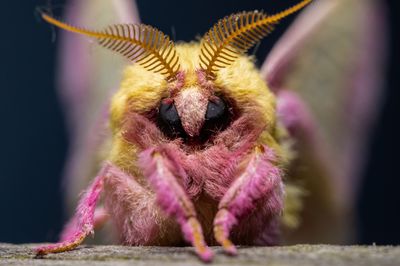


Not all moths are dusty grey or dull beige. Take, for instance, the rosy maple moth, that rocks an incredible combo of colors that make it look like a super-charged flying marshmallow.
The rosy maple moth (Dryocampa rubicunda) is a species within the Saturniidae family, which contains some of the largest species of moths in the world including royal moths, emperor moths, and giant silk moths. However, they are the smallest of the whole family, with a wingspan of 3.2 to 4.4 centimeters (1.25-1.75 inches).
Where to find rosy maple moth
Rosy maple moths are natives of North American deciduous forests, with a range that stretches along the eastern half of the US and nearby regions of southern Canada. Their name comes from their preference for maple trees – if you want to catch a glimpse of one in the wild, then your best bet is to look for these trees.
Their stand-out feature is their pink and yellow coloration, which earns them the nickname “milkshake moth.” The vibrancy of the colors can vary between individuals, with some almost appearing hot pink and neon yellow, while others simply appear creamy white with some soft pink markings.

Why are rosy maple moths so brightly colored?
The color doesn’t camouflage them very well in the woodland environment, but many species of moth have evolved bright coloration to deter predators. It’s basically a giant flashing warning sign saying “WARNING! DON’T EAT! DANGER!”
This defense mechanism is known as aposematism. Many predators know to avoid bright colors as they could signal the prey is toxic. While rosy maple moths don’t have any venom, a hungry bird won’t know that.
Rosy maple moth caterpillar: green-striped mapleworms
Their color isn’t their only strange feature. Just like other species in the Saturniidae silk moth family, adult rosy maple moths don’t have mouths or digestive systems, so they can’t eat. Since they only live for 2 to 9 months, they simply live off the energy stored from when they were caterpillars.
The caterpillars of rosy maple moths are known as green-striped mapleworms and they look fairly inconspicuous, with a light green body and a red head.
They remain caterpillars for a few weeks, gorging on as much food as possible, before entering the pupal stage from which they emerge in their final form: a brilliantly colorful moth.

 1
1