Nature
 PUBLISHED
 1
1


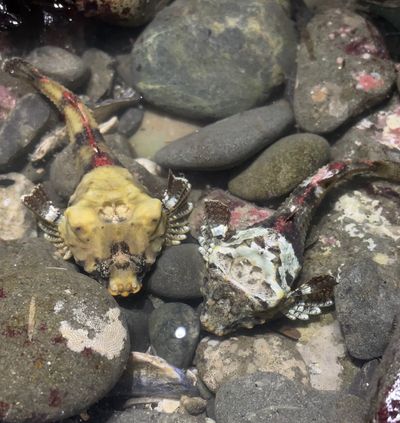


In the US and Canada, along the Pacific Coast, lives an odd-looking fish known as the rockhead poacher (Bothragonus swanii).
First described in 1876, from a single specimen that washed up on a beach following a storm, the armored creature is most noted for its unusual, bowl-shaped head.
"The most remarkable osteological feature of this previously unknown form was a large circular pit in the dorsal surface of the occipital region of the cranium," a previous paper on the topic explains. "A further curiosity was the presence of several small, bony projections extending out into the open space of the pit from its posterior margin."
This cranial pit has been a bit of a fishtery (fish mystery) since the fish was discovered. The fish spend most their time in rocky terrain, often resting motionlessly as it waits to feast on shrimp and crab. Scientists have speculated that the head hole serves as a type of camouflage, or a sensory organ to aid with the fish's hearing, but with no real consensus as to what the hole is useful for.
“The goal of my entire thesis project was to figure out why,” Daniel Geldof, now one of the world's leading experts on the fish, explained in a Louisiana State University (LSU) blog post.
Geldof spent years searching for an example of the rare fish to study, setting out with colleagues and buckets to scour rock pools at low tide. But in the end, with no luck, he had to resort to using samples of the fish which had already been collected in prior years, as well as similar species. Using a microCT scanner at the LSU Advanced Microscopy and Analytical Core, Geldof X-rayed the fish samples from all angles, to create soft-tissue and bone structure scans of it.
The fish are known to make buzzing sounds when alive and underwater, thought to be important to their survival. Geldof traced nerves running from the "hole" to their destination, believing that the hole could play some role in sensing the movement of water around the animal. He found that part of the fish's system for detecting motion, known as the posterior lateral line nerve, did enter the cranial hole, suggesting that the hole was at least in part for this purpose.
However, he also came across some more unusual structures in the fish, possibly hinting at another function.
The fish's first set of ribs, which are large and quite flattened, sit quite closely to the pit without being attached to it. Tendons and muscles surrounding the ribs suggest that the fish are able to move the ribs at will, bashing their ribs against the bony base of the hole like a drum. Other fish are known to communicate through vibrations in the ground, and it appears that rockhead poachers do so by drumming their own heads with their ribs, directing the vibrations through the ground to deter intruders or communicate with other rockhead poachers.
“The ocean, especially in shallow and rocky areas where the rockhead poacher lives, is unbelievably loud and acoustically complex,” Geldof explained. “Sounds carry better in water than in air because water is far denser. If you are scuba diving, you can hear sounds very clearly. However, it’s hard to localize the sounds you hear."
“So, because these fish live in very loud, acoustically complex environments in shallow tidal pools, they have adapted to communicate through the ground rather than through the water.”
The fish are pretty small, reaching around 9 centimeters (3.5 inches) in length, but the cranial hole likely amplifies the sound, helping it be heard in a noisy environment.
“This fish is efficiently using its tiny body so it can still be heard under a unique set of conditions based on where it lives,” Geldof added. “Essentially, it spends its entire adult life in the marine equivalent of a rock concert environment. But it still has to communicate. What's a tiny fish to do?”
Further research is needed to confirm this hypothesis, for instance using microphones placed underwater near the elusive fish. But given how difficult it was to try and track down fish to scan, this could prove pretty troublesome. For now, you can rest easy knowing that there's a fish out there which is likely using its ribs to play its head like a drum, or is at least capable of doing so by the looks of its anatomy.