Nature
 PUBLISHED


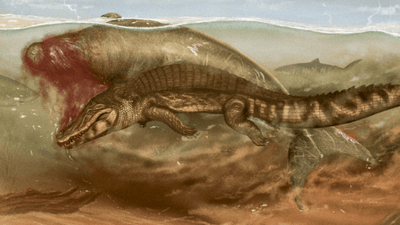


Between 23 and 11.6 million years ago, an unlucky sea cow had a very bad day. It got munched on by not one, but two types of carnivores as it became dinner for both a shark and some kind of ancient crocodilian. The most unfortunate of sandwiches.
The gruesome scene has been pieced together from fossils of the poor old sea cow, with bite marks indicating the crocodilian tried to suffocate its prey in a "death roll". There was also a shark’s tooth found by its neck and bites along its body, demonstrating that multiple prehistoric predators attended the feast.
The dugongine sea cow in question belonged to the extinct genus Culebratherium that dates back to the Early Miocene. Their fossil remains are described as “quite peculiar in appearance” by expedition lead and study co-author Marcelo R. Sanchez-Villagra, who is the Director at the Palaeontological Institute & Museum at Zurich in a statement.
Fortunately, it was precisely the strangeness of their fossils that brought the team to excavate the remote site that was 100 kilometers (62 miles) away from anywhere else they had been looking. They were tipped off by a farmer who had noticed what they thought were some unusual-looking rocks, unknowingly leading to the discovery of a truly remarkable fossil find that opens up our understanding of an ancient ecosystem.
“Our findings constitute one of the few records documenting multiple predators over a single prey, and as such provide a glimpse of food chain networks in this region during the Miocene,” said lead author Aldo Benites-Palomino, from the Department of Paleontology at Zurich.
“Today, often when we observe a predator in the wild, we find the carcass of prey which demonstrates its function as a food source for other animals too; but fossil records of this are rarer. We have been unsure as to which animals would have served this purpose as a food source for multiple predators. Our previous research has identified sperm whales scavenged by several shark species, and this new research highlights the importance of sea cows within the food chain.”
The predators within that food chain included an ancient crocodilian that appears to have grabbed the sea cow by the snout, possibly in an effort to suffocate it, as we know crocodiles today love a good death roll. The spinning maneuver can subdue and dismember prey as the crocodilian rapidly rotates along its longitudinal axis – like a dramatic log roll, if you please.
Then came the shark. A tooth of the tiger shark species Galeocerdo aduncus was found between the sea cow’s neck and ribcage, and there was evidence of shark bite marks along its skeleton. It appears the toothy fish may have scavenged what was left after the crocodilian was done.
The fossil discovery marks an incredibly rare find – it’s not often you find fossilized evidence for two kinds of carnivores feeding on one type of prey (we do get the occasional carnivorous conga line, though). It might have been a very bad day for that sea cow, but it helps to piece together the food chain puzzle of the Miocene, something we rarely get to do.
Just goes to show you should always pay attention to a weird-looking rock.
The study is published in the Journal Of Vertebrate Paleontology.